Creative Writing is a pyramid scheme

(In 2009 I wrote some posts for literaturenetwork.org. The site in question is no longer available so I'm posting the pieces I have copies of to my weblog)

Creative Writing is a big business. A few years ago the BBC claimed there were more than 600 full time creative writing degree courses at British universities. These included options such as Accountancy with Creative Writing (currently available at the University of Derby).  Hundreds of less-formal courses are available, as well as shorter seminars and residential breaks. Requiring little more than desk space and a tutor, such courses are easy to put on and profitable.

These courses need to distinguish themselves in a crowded market and one way they do this is to offer access to agents. The courses are underwritten with the promise, not that you will be trained to be a better writer, but that you will gain access to the literary world, and through that achieve the dream: giving up the day job to become a writer. Inevitably, as Hanif Kureshi pointed out at a recent appearance, false expectations are created. Few courses mention how far the reality of writing is from the dream:

  • In 2001 the Society of Authors claimed that three-quarters of writers made less than £20,000 a year.
  • A 2006 Independent article asserts that “the average author earns less than £7,000 a year.Anthony Beevor describes one writer whose books were so heavily discounted that he sold 40,000 copies yet, financially, “he would be better off working the till in Sainsbury’s”.
  • In 2007 the Independent reported statistics from the Authors’ Licensing and Collecting Society that “£907.5m is earned by the 55,000 authors in Britain every year but 50 per cent of the cash goes to 10 per cent of the authors, meaning that the 5,500 bestselling writers share at least £453.75m of it, giving them an average annual income of £82,500 while the other 49,500 authors share the rest, typically earning £4,000
  • The same article includes a heartbreaking case study of a writer with a significant audience who is suffering financially. She concludes: “the best advice if you want to eat is: ‘Do something else.’"
  • Even those stories of huge advances can’t be trusted. The rumoured £1,000,000 advance given to Magnus Mills was, in reality, closer to £10,000.

Making a living from creative writing is difficult. As Lydia Towsey pointed out in a recent Literature Network post, a working poet’ now means to diversify… workshops, producing, directing, mentoring and other types of writing are all vital for the buying of bread.

So what about those creative writing courses that promise a route to literary success? Participants expecting to make a living from creative writing are most likely to achieve this by teaching. From this angle the creative writing industry looks like a pyramid scheme. At its worst I’ve seen people whose only credit was an MA from a good course going on to teach their own informal courses. Considering the economics involved, one wonders whether courses would be better off spending less time teaching structure and form and more on teaching how to promote and facilitate a creative writing course.

Of course I’m teasing – mostly. I’ve attended some courses myself and had a great time, making some wonderful (and some lousy) friendships. The creative writing courses have led me to performing my work in public and have undoubtedly enriched my life.

There’s a serious point here though, and that is that creative writing courses need to focus on the benefits they can guarantee to give students – ‘life skills’, for want of a better term. Through creative writing courses I’ve come to read my work in public, making me more confident in my day job and social life. An awareness of writing allows me to produce all sort of copy, and edit other people’s work. Furthermore, studying any subject in a serious manner hones a range of useful skills.

Like a lot of people who’ve taken creative writing courses I’ve written my own novel and I certainly want to see that published. But if it isn’t, and I’m still doing my day job in ten years time, I won’t feel like I’ve wasted my time with ‘creative writing’. What concerns me is that too many people start courses with the expectation of certain results, and leave with those notions intact, always disappointed with their lot.

Supported by Writing East Midlands

(It's interesting to look back on this article. Since this was published, I set up the Brighton Creative Writing Sessions with Ellen de Vries, experimenting with creative writing workshops that were self-contained and entertaining, focussing on writing rather than publication. I was always uneasy that we charged for these (although we intentionally made no profit after expenses). My main involvement with 'creative writing' nowadays is through Not for the Faint-Hearted, which is a good example of the sort of thing I was arguing for here).

Not for the Faint-Hearted 2012

After a long break, Not for the Faint-Hearted recently resumed its regular monthly slot. Last week was the second 2012 session and about 18 people came along.

The Not for the Faint-Hearted (NFTFH) sessions are based around a series of visual 'creative writing' prompts projected on a screen. Everyone writes for three minutes in response - a story, poem, dialogue, limerick, or simply a description of what they see. Then everyone takes a turn to read something or all of what they've written. There is only one rule: you are not allowed to apologise for what you read. While some people recoil in horror at the idea of NFTFH, everyone who comes seems to enjoy it.

I started the group in October 2009 with Ellen de Vries. NFTFH was originally intended as an experiment in creativity. We wanted to see what happened when people took risks and presented unfinished work. We were surprised by how good the work we heard was.

For some reason, the stories people wrote in three minutes were better than many of the pieces I've heard at open mike nights. Three minutes gives people just enough time to come up with an idea and produce something simple around it. We don't do rounds longer than three minutes because the work that results is less interesting.  

The attendees all seem to enjoy themselves and have a variety of reasons for coming. The thing that keeps me running the sessions is that I love the stories produced. In last week's session I heard almost 150 pieces. Some of them made everyone laugh out loud; all contained some interesting element. And when a story doesn't work, there's another one along moments later.

I don't know what to do with all the stories I've written at the sessions – possibly a couple of hundred.  Some are too closely tied to the image to be interesting, but one has found a home on Myriad's Quick Fictions app. I might post some here, or bundle the best ones into a Kindle file, but that isn't likely to happen any time soon.

One of the most important things about Not for the Faint-Hearted is the Skiff. Without their support, it wouldn't be possible to run the night and I'm very grateful to them for that.  

A Swenglish attempt on Mount Caburn

DSCN2548

My friend, the Swedish writer Louise Halvardsson, has recently been working on her Swenglish project. This involves Louise spending a week with 30 different people, 15 in England and 15 in Sweden. As well as being a fascinating idea for an art project/alternative travel memoir, Lou is also hoping to decide whether to settle in England or Sweden at the end of it.

The project requires Lou to shadow her hosts for the full week, meaning that her free-time depends on what they want to do. This means that I’ve not seen much of Lou since I returned from my holidays, except on her weeks off. Since last week was a free week we met up and tried another of the Cheeky Walks, this one an expedition to climb Mount Caburn.

The weather wasn’t as good as my previous walk, but it was dry and the scenery was fantastic. Mount Caburn is an iron-age fort near Lewes and has some lovely views. Lou’s account of the walk is online in English and Swedish.

DSCN2553
DSCN2556

DSCN2564

DSCN2576
The directions on this walk weren’t quite as straightforward as the last one, and we managed to get lost around Glynde. Trying to get back to Mount Caburn we found ourselves on an obscure path that hit a dead end:

DSCN2578

DSCN2581

Signs of civilisation:

DSCN2579

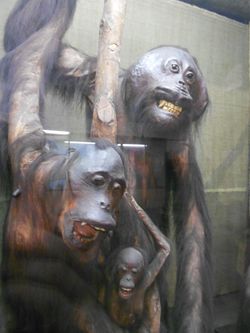
The notices about gorillas made us wonder if we were more lost than we thought:

IMAG2263

Strange details in Lewes:

IMAG2262
IMAG2261

Prometheus and Catastrophic Project Management Failure

(This post contains spoilers for Prometheus.)

When I say I expect science-fiction to be realistic, it’s probably worth defining what I mean. I’m willing to overlook the existence of AI robots and starships in a film set 70 years in the future. I’m willing to overlook inappropriate design decisions in the space ships and user-interfaces. But I expect the characters to behave like people. Characters should be consistent and make sense to a reasonable cinema-goer.

Which is what annoyed me about Prometheus. You’re sending a space-ship two years and unthinkable distances from Earth to contact an alien civilisation. I expect the team chosen to show the basic competency one would expect from people at the top of their field. The film’s plot was entirely dependent on the incompetence of the characters.

So, with that in mind, let’s look at some of the disasterous errors made by the Prometheus crew. Seriously – I wouldn’t cross the road with these people, let alone contact alien races. Look on this as a helpful project review.

Lack of clearly defined goals Setting aside the differing agendas, nobody had a clearly defined aim. While it’s valid for metaphysical concerns to inspire your project, you need to define a goal so that everyone can share it and evaluate decisions against it. It’s also hard to tell whether your mission has succeeded unless you know what you’re trying to do.

No contingency planning Most projects have undecidables, even without encountering alien races. You should probably have some idea what you might do when certain things go wrong (biological contamination being an obvious one). Rather than sleep the two years before arriving on the planet, I’d have had some of the crew watching science fiction movies and working out what they would have done in those scenarios, and then producing appropriate processes.

Process not present or ignored Which is the next thing: clearly defined processes are a life-saver in stressful situations. Checking in code or handing over between teams can be difficult under pressure, so strict processes are used to maintain good standards. And one would expect clear processes about handling potential xeno-biological contamination – not to simply allow the crew to wander off for sexy-time.

No chain of command or teambuilding The team had no clear idea who was in charge. And having such an important team meeting one another for the first time in another solar system is insane. Everyone needs to be comfortable working together before going to meet alien races.

No data collection or analysis The crew woke up shortly before landing on the planet. This is a place that has been waiting millenia – there is no harm orbiting a few times collecting data. Or maybe sending the mapping probes into the caves before a full team follows. Take your time to gather information and think about the next step rather than blundering forward because you’re stressed or excited.

Undefined roles Several of the team didn’t know what they were doing there – why was the geologist in the first team when he didn’t need to be (he also seemed somewhat enthusiastic about rocks – you think he’d have been more excited about the structure of the caves). And those who did have a role were ignored. A security expert is employed for a reason – if he says you’re taking guns then no-one else should overrule him except a clear superior. Domain experts should have authority over their domain.

Quite frankly, the crew of the Prometheus were a shabbily organised embarrassment to the human race. It is a good thing that real life companies run more efficiently than this.

Are You Experienced? – my favourite book about India

Are_you_experienced

It is probably best to arrive in India when feeling calm and rested, after a good night's sleep. Unfortunately, after a 14 hour flight, I'm not generally at my best.

The first time I landed in India, a couple of years ago, it was a shock. Delhi can feel very hostile to new arrivals. Soon after arriving at Paharganj, the backpacker's quarter, I had to find some rupees to buy bottled water. Dazed, I was swarmed by touts. They could tell I had just arrived and were eager to divert me. I ignored one persistent tout, who worked through a repetoire of openings to get a reaction. He finally came out with "Why don't you go back to your own country".

This year I arrived in India feeling more confident but the start of a long trip always makes me nervous. To relax myself as I queued for immigrations, I started to re-read Are You Experienced. This is my favourite book about travelling in India. I originally read it before my first trip and it was more interesting and thought-provoking than the numerous worthy texts by white BBC journalists.

In re-reading I recognised many of the misconceptions I had on my first trip. The book is scathing about travellers, questioning the reasons why people travel to India, skewering traveller stereotypes and laying out the stages tourists go through when trying to understand a country as complicated as India.

The novel follows Dave, a gap-year student. Dave decides, on a whim, to visit India with his best friend's girlfriend, the insufferable Liz. Dave finds India difficult to deal with and has various encounters and misadventures. Without being didactic, Dave's encounters illustrate some interesting points about travelling in India.

The book discusses the temptation to develop 'theories of India', with the travellers competing with each other over their interpretations. At one point, Dave decides that he most enjoys travelling between locations, where he is not hassled by touts but instead ends up sharing food with other people on the train. "I had assumed that travelling was the crap bit you had to tolerate in order to get to the places that you wanted to see,  but it occurred to me that maybe the places were the shit bits that you had to tolerate to do the travelling".

Among the jokes and clever observations are some excellent points. When a train breaks down, Dave seeks the company of the only white person he can see, who turns out to be a Reuters journalist. The conversation goes badly as Dave is mocked for having no idea about the current political situation in India, or what Congress or the BJP are. When Dave defends himself by saying that he doesn't have to revise for his holidays, he comes off second best.  The journalist's resulting rant is fantastic, attacking the idea of treating India as a character-building exercise, a more exotic alternative to mountaineering or running a marathon.

The book also contains an epic dysentry scene which acts as the Campbellian crossing of the threshold. There is also this particular quote towards the end:

"I'd never been jealous of the older travellers before, because most of them were such transparent social failures. The people in their 30s who were still trudging around India had so obviously cocked-up their entire lives that there wasn't much to be jealous of."

I didn't read much of the novel before we were through immigration, finishing it in the hotel that night. Bangalore was peaceful compared to Delhi. We checked into the hotel without problems then helped a German tourist to find the station. I am an older and more experienced person than I was on my first visit.

The Singing Sculptures of Churchill Square

I've been in Brighton long enough to remember the old Churchill Square: concrete everywhere, with dingy corners like the one where the computer shop, Softcenter, skulked by the toilets. At the center was William Mitchell's sculpture, The Spirit of Brighton. A 30 foot high piece of concrete, it looked like a strange climbing wall. According to Timothy Carder, author of the Encyclopedia of Brighton, it was "intended purely as a 'piece of fun'.. but in reality it epitomises the dreadful concrete redevelopment of Brighton in the 1960s and 70s".

Wwwcitylibrariesinfo_00487_s

The old Churchill Square was opened in 1968 and the current center opened in the late 90's. It is hard for me to overlay the old version on top of the new one – there's something overwhelming about the new building, with its strange subterranean light.  The Spirit of Brighton was demolished as part of the redevelopment. 

Postcard

Outside the new Churchill Square are two sculptures called The Twins. It was only recently that .scribe told me that this scuplture is interactive. According to the artist Charlie Hooker's website, "Sounds emanating from it, and images etched into its granite and bronze surfaces are derived from graphs produced by weather patterns specific to its location which were produced over the full year prior to the work's installation. The gentle sounds are produced by solar-controlled electronic devices which attatch to the bronze panels, causing them to produce sound. The piece is at its loudest on bright, sunny days".

IMAG2158

One evening recently I stopped to listen to the sculptures. Putting my ear right up to the metal panels I could hear low tones. People notice when you listen to sculpture, and I saw one kid trying the same himself. I explained about the music but he shrugged. "I swear, I can't hear nothing," he said, and put his headphones back on.

A Cheeky Walk through Southease and Rodmell

DSCN2464

The Cheeky Book of Walks was released last month and I only just got hold of my copy after sending it to the wrong address. On Sunday I set out with @vickymatthews and @booleandavid on the 'Suicide Stroll' a 5 mile circular route from Southease Station. The route passes Virginia Woolf's house and follows the walk she made on the way to take her own life.

DSCN2472

It was a hot day and Sussex looked beautiful. I don't venture into the countryside as often as I should. And every time I take a rural walk I curse this fact and promise myself I'll do it more in the future. The Downs are so beautiful that I should make more of them.

DSCN2488

My grandfather won prizes for his ploughing. I'm sure he would have done a better job than whoever ploughed this field:

DSCN2496

DSCN2501

In Rodmell village, opposite the Abergavenny Arms pub, is a small 'shrine' to Frank Dean. One of the posters lists his favourite sayings including "To justify spending money on oneself: there are no pockets in a shroud" and "Well blow me down, I'll go to Peacehaven in a rowing boat". It was a touching memorial.

DSCN2519

DSCN2516

I wondered why someone had nailed burlap sacks onto a wall. I found out from @MattPope on twitter: "repointed mortar on a wall repair. It must dry slowly or it'll turn to sand and blow away in the wind."

DSCN2527

The route passed Monk's House, where Virginia Woolf once lived. According to our guidebook, the house was closed and the gardens only open on a Wednesday and Saturday afternoon. We were in luck, however, because this has changed since Cheeky Walks was printed – we could tour the gardens on a Sunday and also wander around the house.

DSCN2535

A small display showed some of the visitors who had come to the house. Among the photos was one of EM Forster with TS Eliot. I would love to have had a chance to hear some of their conversations. 

IMAG2207

Resting under a tree in Virginia Woolf's garden, I felt incredibly relaxed. Vicky had bought some curried vegetable soup so we had a discreet picnic…

IMAG2213

…then quickly washed up in the garden.

IMAG2214

From Monk's House it is a short walk to the River Ouse, where Woolf took her life. The stretch of the Ouse near Southease is a scummy, brown, ugly river. I don't know what it was like in the 40s, but it seems a sad place for someone to die.

IMAG2228

IMAG2233

IMAG2241

"If anybody could have saved me it would have been you. Everything has gone from me but the certainty of your goodness. I can't go on spoiling your life any longer. I don't think two people could have been happier than we have been." (from Virginia Woolf's final letter to her husband Leonard) 

Psychogeography Workshop

DSCN2421

On Saturday I held a psychogeography workshop at the Artist Residence Hotel as part of Kate Shields' Different Ways of Seeing events. It was an incredibly hot day, so it was good to be able to hide in the hotel. We had a discussion about the history of psychogeography then set off to the beach for a couple of practical experiments.

The group divided into pairs and walked along the seafront blindfolded. The promenade was incredibly busy but, typically for Brighton, nobody paid any attention to the people in blindfolds. The pairs were then sent off with maps to explore different routes through the town.

Considering most of the attendees had no idea what they were in for, everyone was very enthusuastic. It was a fun session to run and hopefully I will do another in the near future.

DSCN2408

Below are some photos taken by Frankie on her ramble about town. Frankie also pioneered the concept of wearable psychogeography, returning to the hotel wearing a new hair decoration, a child's toy windmill she'd found on the way.

DSCN2428

DSCN2435

DSCN2437

DSCN2433

DSCN2418