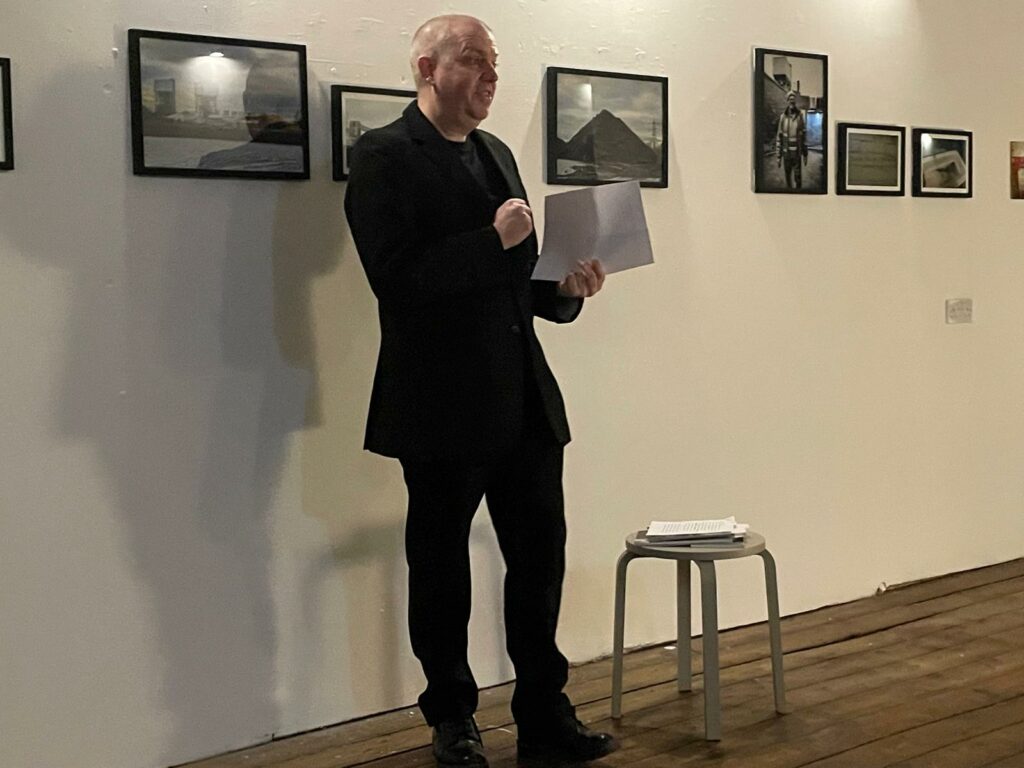
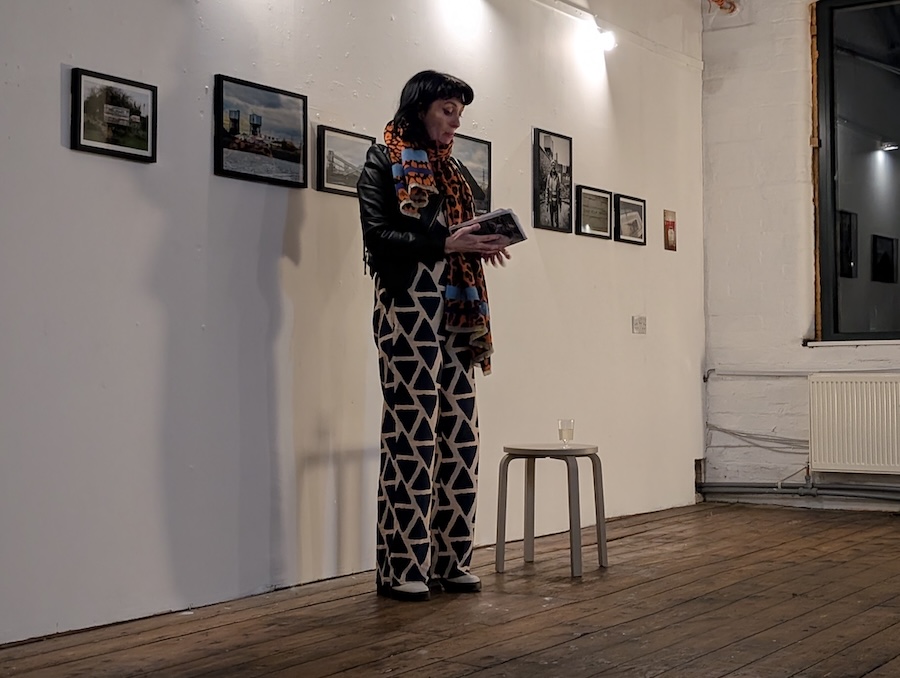
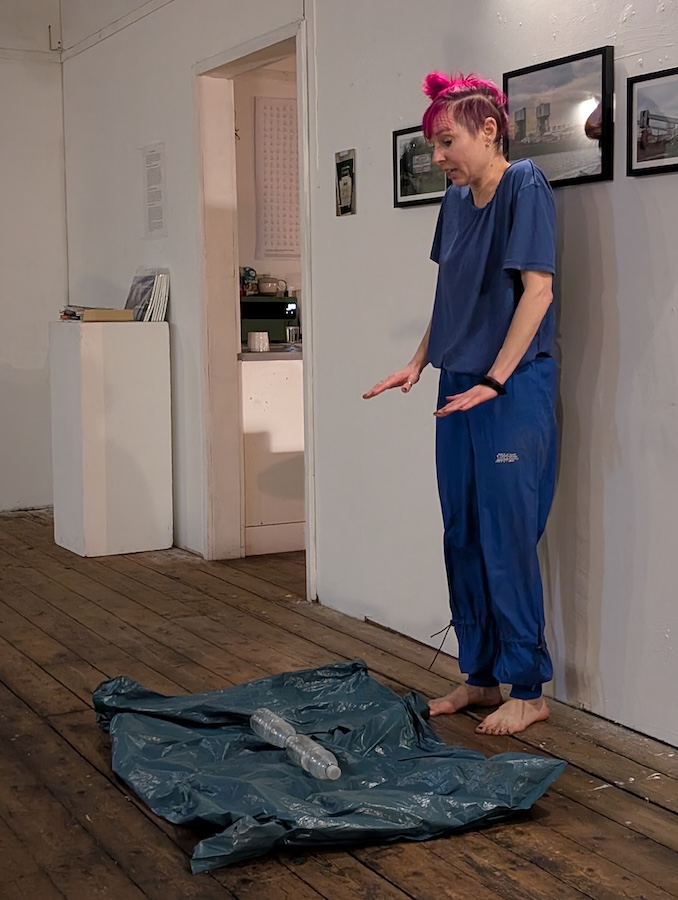
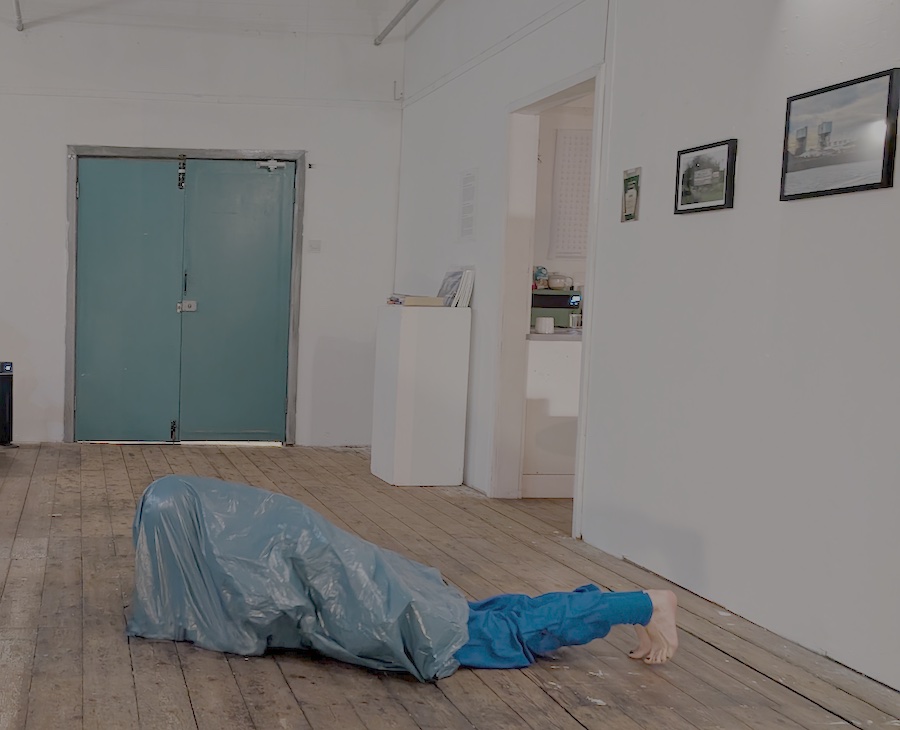
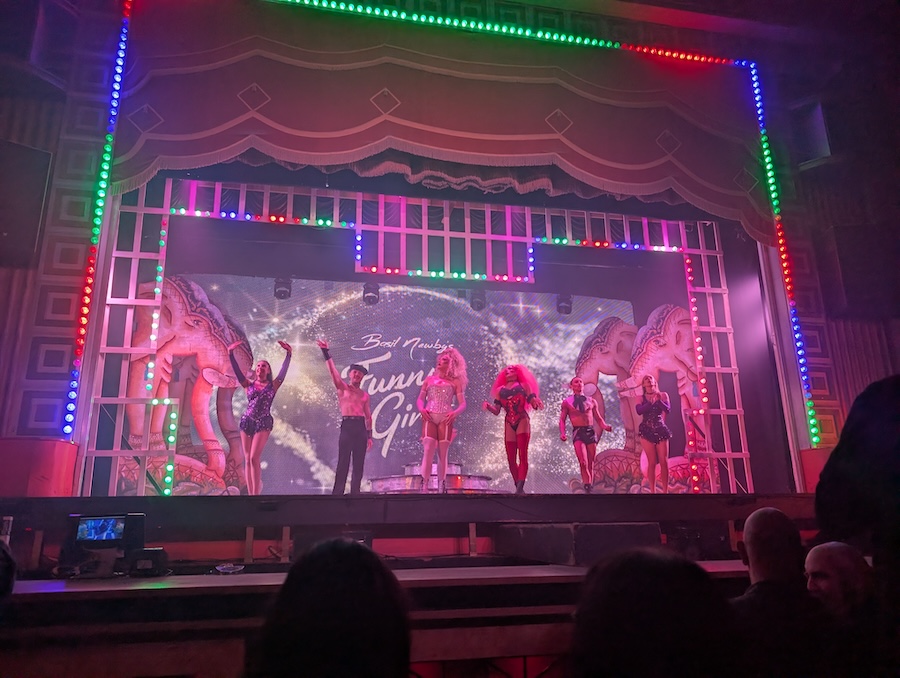
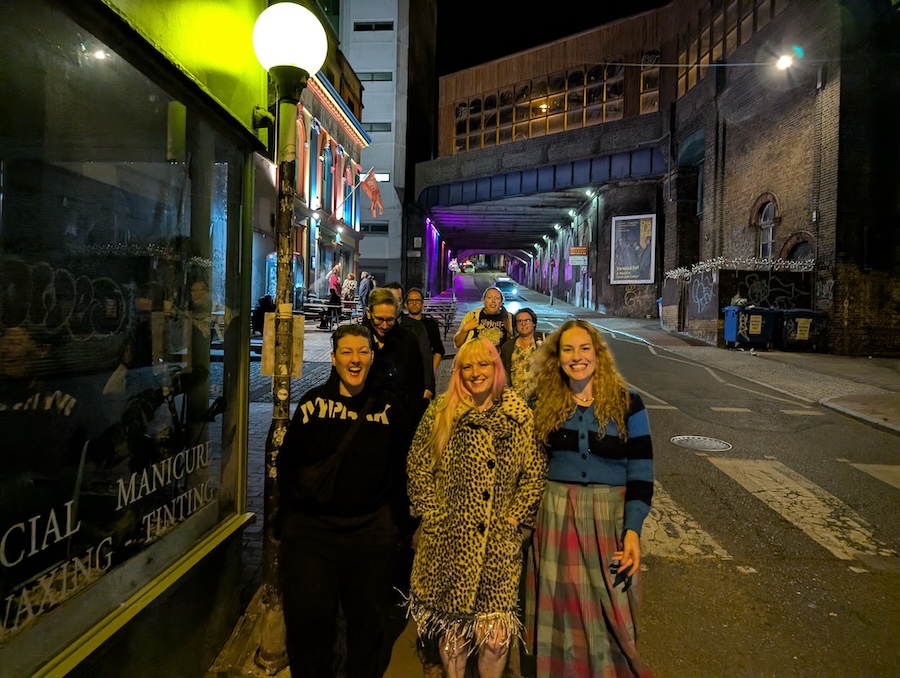
It’s been a very long time since I put on a spoken word event, but last weekend I organised a show at In a Land Gallery featuring performances from me, Toria Garbutt and Louise Halvardsson. (Rosy would have joined us, but was taken ill after her Derby show the night before).
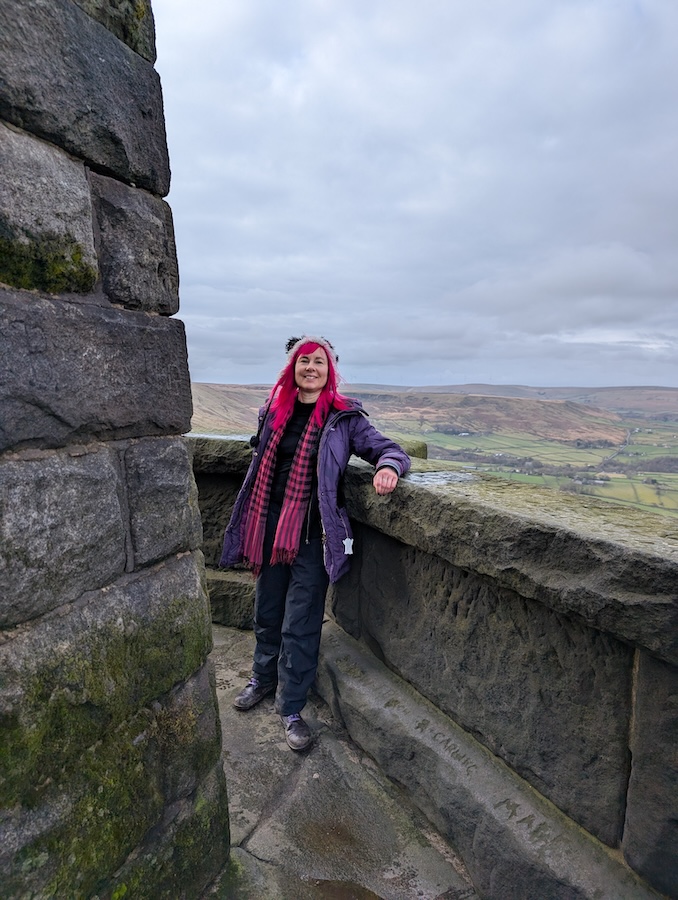
Lou at Stoodley Pike
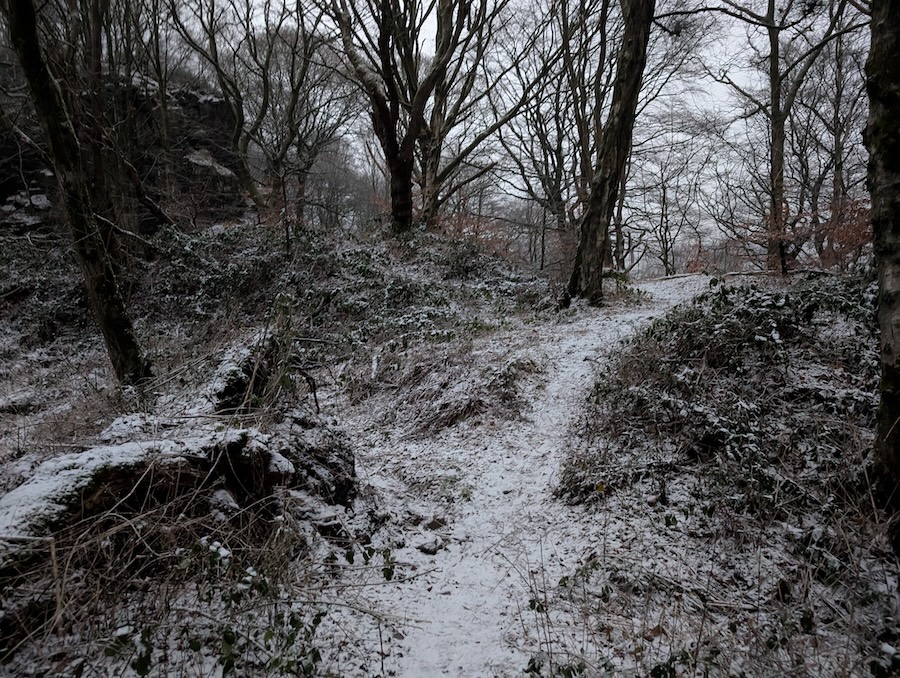
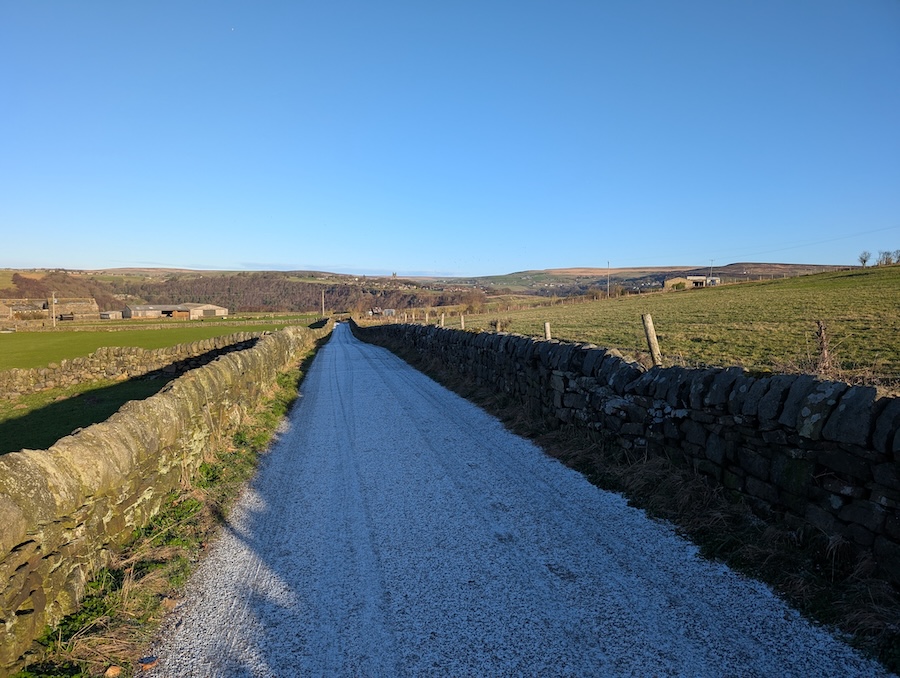
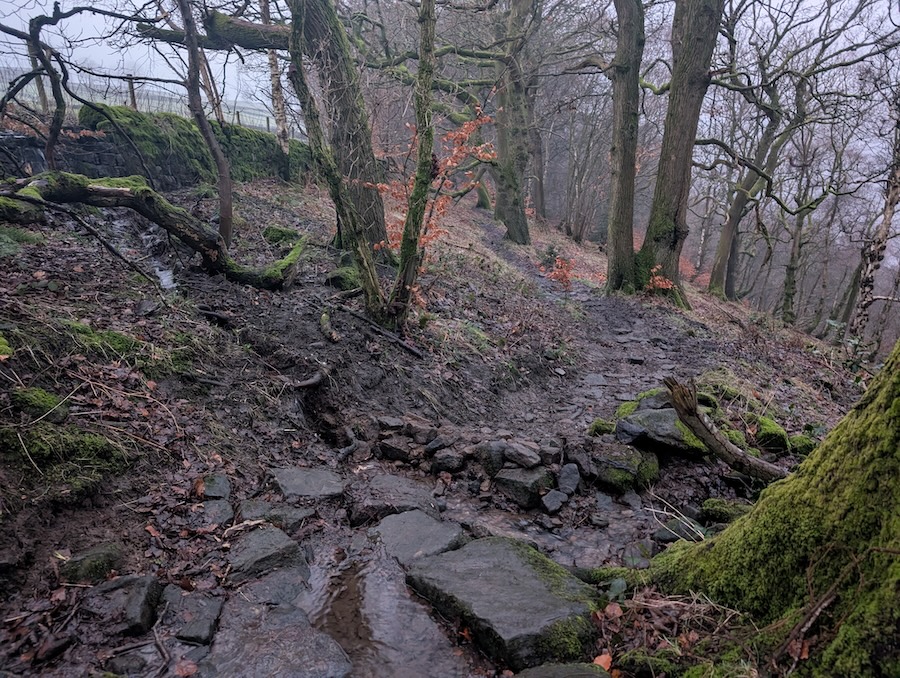
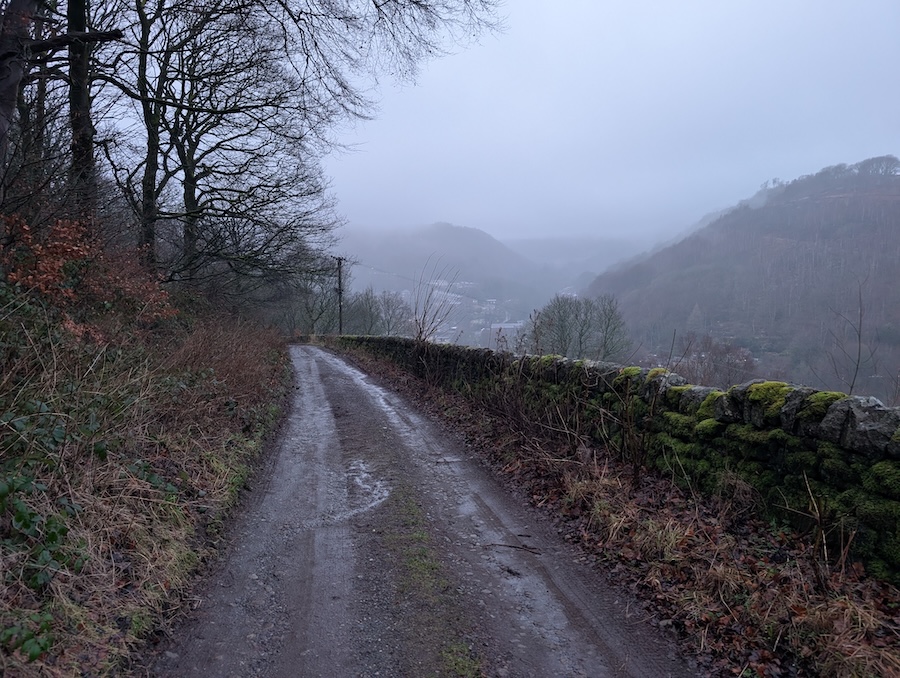
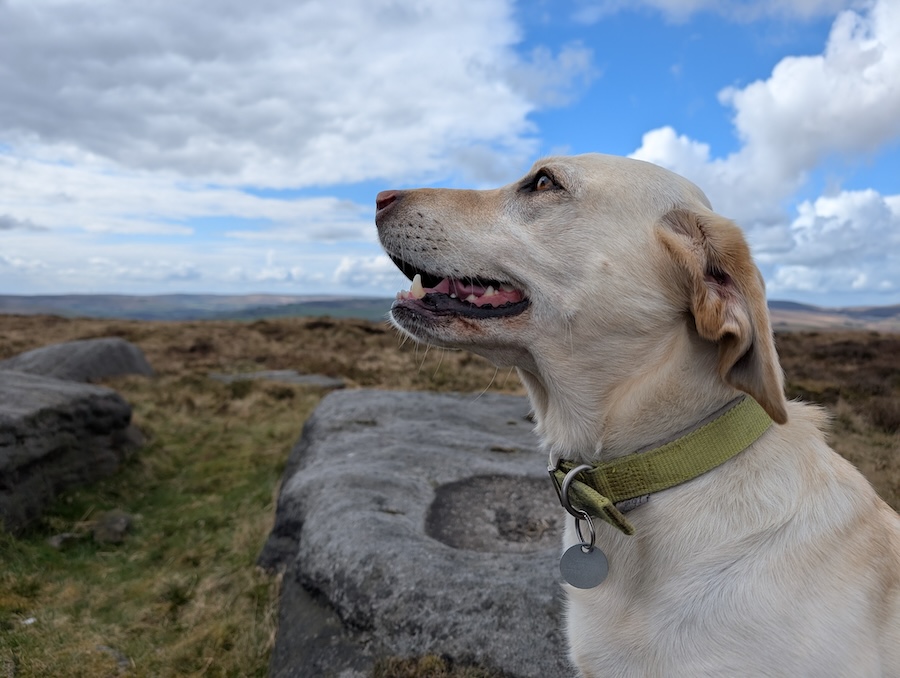
The day started with a hike to Todmorden, visiting Stoodley Pike on the way. I’ve been slack about hiking since the South Downs Way in June, so it was good to be out on the hills. In Todmorden, we bought some books from Lyall’s, ate ramen at the Ginger Tiger, then headed home so I could prepare my performance. (I should have done that days ago, but I’m more just-in-time than I used to be).
I did some short stories, including a new one about Wuthering Heights. I read another couple of longer pieces, A Bad Place to Stick Your Hand and meat. I’m alarmed that they are both almost 20 years old. I also read some microfictions, which seemed to go down well.
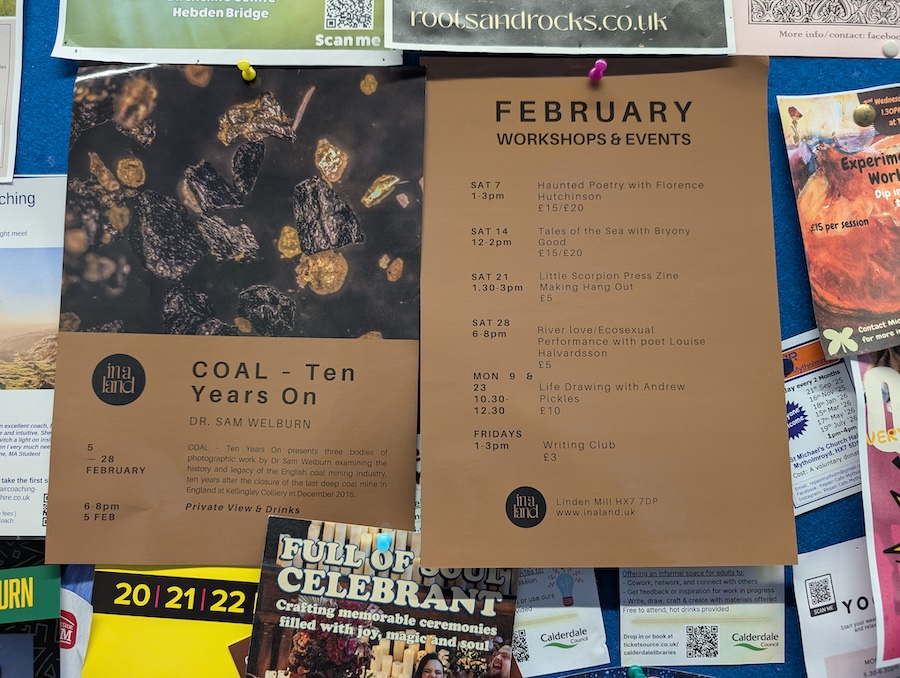
Toria performed a poem about growing up in Knottingley, to a backdrop of the current exhibition, which featured images of nearby Kellingley Colliery. Her short set ranged from heartbreaking to very funny. I love watching Toria perform.
I introduced Lou at the end of the first half so that the final part of the show could be completely devoted to her work. I’ve been friends with Lou for a long time (I wrote a post in 2012 about hiking around Mount Caburn with her). I originally knew Lou as a slam poet but her new work is experimental, featuring movement and sound poetry. The piece was based on her forthcoming Swedish collection and had been specially translated into English. It was a fun show, and very different to any other performance I’ve seen.
The best thing about the event was that most of the audience joined us in the pub afterwards. For me, that’s the best thing about In a Land – Bryony has built a lovely community. I knew some of the people who came to the night from recent writing workshops.
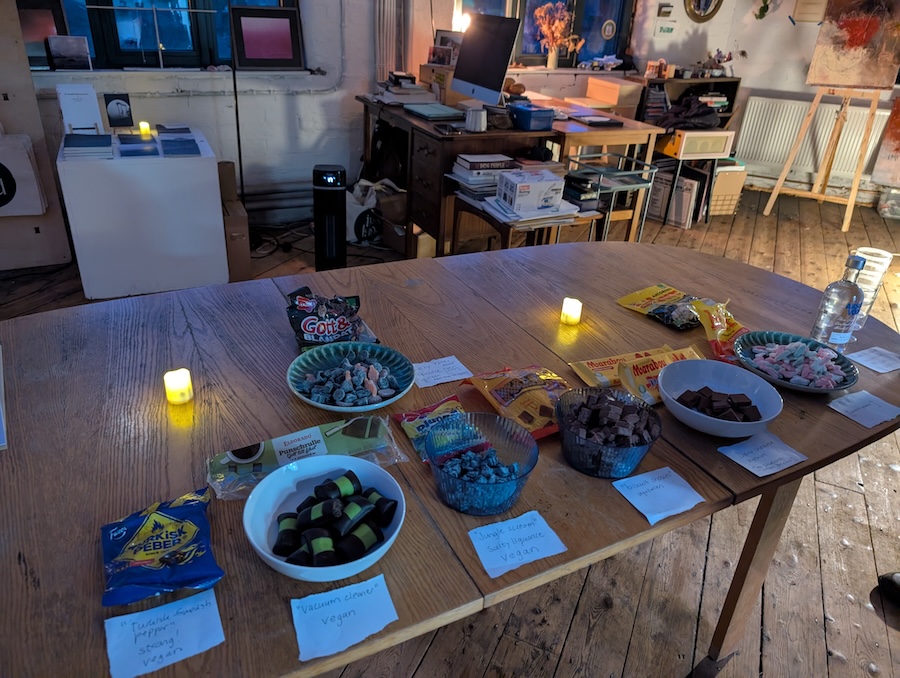
A table of Swedish treats
Running the event was hard work – and I fretted a lot about whether we’d get enough people in. But we filled all the chairs and had a great evening. I love that I helped to make something like this happen.
According to the Covid Calendar, it is March 2,112th 2020 – almost 6 years since the covid lockdowns. And, for the first time, I have a confirmed case of covid. I’d begun to wonder if I was somehow immune – I guess the best I can hope for now is ‘resistant’.
At the end of last week, I thought I had a cold, and casually went on with my life. I rested most of the weekend but, by Monday, my throat became painful. Whoever described it as ‘razor blade throat’ did a good job, and gave me a clue what had happened. The final confirmation came with two lines on a covid test. I tried to work on Monday, wanting to keep abreast of urgent tasks, but by lunchtime I submitted to not being well and needing to rest and recover.
I’m not the only person in the house – we have a friend staying too – so it’s been an old-fashioned quarantine for me, confined to the top floor. It’s not so bad – I’ve had delicious meals delivered, and so far nobody else has tested positive. I’ve been tired mostly – napping and catching up on my letterboxd watchlist.
It’s strange to finally get covid when it barely matters, particularly after all the fuss in 2020/21. Covid was such a huge event, and it sometimes feels like it never happened. Odd traces persist – like ghost signs in the streets, this article about queueing in pubs. Isolating with covid in 2026 feels a little like being a time traveller, trapped in 2020. At the start of March 2020, it seemed that things would have been very different because of the pandemic. It turned out to be business as usual, but slightly worse.
Work started a few days into 2026 and was immediately 100 miles-an-hour. I’ve been trying some new approaches to make things less tiring, which are mostly working, and I’m less frazzled than I was. It’s been a busy month outside of work too – workshops at In a Land gallery, a trip to Blackpool, and Rosy’s club night. The weather has varied between icy and quite warm. I’m doing a lot, but I’m mostly happy.
At the start of January my weight lurched out of control, reaching its highest level. This is the culmination of a long, creeping rise since starting with my current client. I still don’t have the capacity/schedule for a regular exercise session, so I’ve put myself on a diet. It hasn’t been too extreme, just cutting out the more indulgent treats. I’m walking a little more too. I’ve brought myself down from the peak, and am moving slowly in the right direction.
Having complained about deadlines throughout 2025, I’ve got several coming up. I’m writing a new performance piece for a poetry night I’m putting on in February, featuring Lou Ice doing her latest work. I attended both Wednesday Writers sessions, as well as some amazing workshops at In A Land. Bryony showed me how to bind my own books and I’m excited about doing some very short-run volumes in the near future. My aim for 2026 is flow, and I need to be getting more work out, but that will come. I did send out my first email on the new Buttondown mailing list.
I watched a lot of interesting films this month. Marty Supreme was fun, if a little flimsy. Kill Bill felt tiresome and over-long as a single movie. Sentimental Value was beautifully made, but kind of dull – it reminded me of Houllebecq’s comments about realistic fiction being less interesting than fantasy. Sentimental Value was a great haunted house movie that lacked a ghost. Hamnet felt emotionally manipulative and failed to impress me as much as it did the rest of the audience. The Bone Temple had fewer zombies than expected, but was incredibly entertaining (wow, that musical number!).
Train Dreams was a stunning view of a man’s life. Rosy and I streamed Emma Thompson entertaining thriller Dead of Winter. It was the 40th anniversary of Blue Velvet, a film I’d not seen for many years. Rewatching it was uncomfortable and troubling – the film’s vicious misogyny was impossible to ignore. Another uncomfortable film was Sofia Coppola’s Priscilla – while I didn’t love it, it was an excellent work of biography.
I picked up a 99p copy of Mick Herron’s Clown Town at the start of the month, and stopped in the first chapter – I don’t have time to read the same Slough House book I’ve read before. Spread Me was a good body-horror. The Bog People anthology was a great concept, but the execution didn’t work for me. I read a couple more Jarett Kobek books and loved Soft and Cuddly, a discussion of an old video game – I wasn’t sure if it was real or invented. John Langhan’s Lost in the Dark was an interesting story collection. Naomi Alderman’s Don’t Burn Anyone at the Stake Today was thought-provoking and deserves a post of its own.
My only regular TV show at the moment is Spartacus: House of Ashur. This is flamboyant, unrepentant trash, but does that job well. Rosy and I also watched Taylor Swift’s End of an Eras documentary which varied between annoying PR exercise and fascinating competence porn. All other things aside, it was interesting to see the sheer scale and impact of the Eras tour.
I’ve been meaning to delete the Substack newsletter for a few weeks now, but have not quite gathered the courage to do it. But, overall, I’m enjoying not being on social media. My views feel less extreme than they did, and I’m calmer about some controversial topics. Reading Naomi Alderman’s new book has me thinking about the urgency of calming down social media in society as a whole. Letting corporations inflame peoples anger to sell ads is not working well.
The 2025 Mycelium Parish news has been through a round of revisions, so just needs the layout, which will hopefully happen in February. This has been a slog, mostly due to the compilation being so chaotic. This is something I’m trying to solve with the 2026 edition. This is already at 900 words and going much more smoothly.
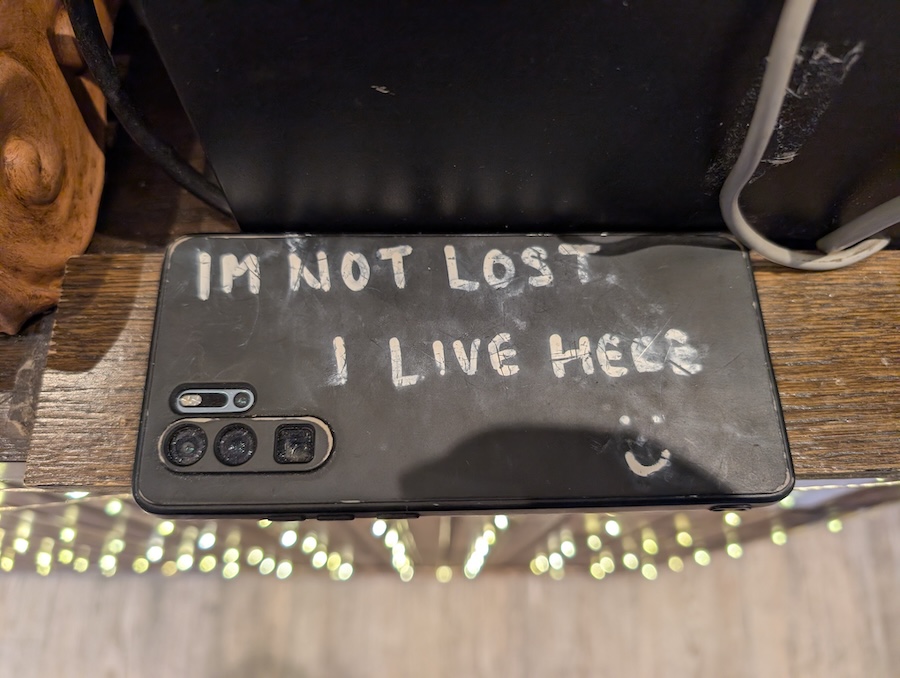
Found horror story
I’ve been taking trying to apply the principle of mise-en-place in both work and outside. I’m trying to keep things tidier as I go, hopefully preventing them descending into chaos. This is mostly working, although there’s the usual problem that becoming more organised feels like an invitation to take more on.
Someone dammed a stream on my daily walk to divert it from the footpath.
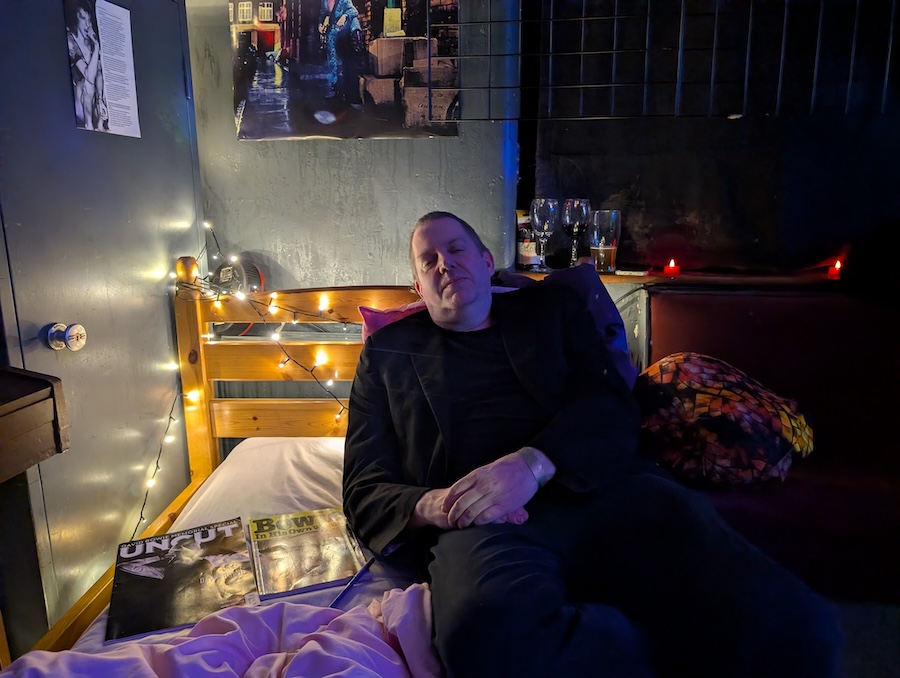
I read tarot cards at Rosy’s David Bowie event. I’m not a great tarot reader, and reading in clubs presents challenges, but I had fun (and hopefully the querents did too). I’ve now read at two of Rosy’s events and I’m grateful to her for moving me beyond simply reading about tarot. It’s something I want to practise a lot more.
I had such a long break from work that I worried I might have forgotten some of my passwords.
I’ve been trying to touch type over the past few weeks. It’s proving hard to pick up the discipline, but I am improving.
I picked up a cheap kindle copy of Gurnaik Johal’s novel, Saraswati, and have it cued up to read after You Dreamed of Empires. The Guardian review is lukewarm, but attracted me with this section:
…his first novel is a representative example of a ubiquitous 21st-century genre. That genre lacks a name – in 2012, Douglas Coupland proposed “translit”… its features are all too recognisable. These novels contain multiple narratives, each set in a different country if not continent, often in a different century. Although long by modern standards, they are packed – with events, themes, facts. They address themselves to the big questions of the day, not by the traditional means of examining urban society but through a kind of bourgeois exotic. The characters are paleontologists, mixed media artists, every flavour of activist, but never dentists or electricians. The settings are often remote: tropical islands or frigid deserts.
The reader puts these novels together, like jigsaw puzzles. This term won’t catch on either, but one could call them “connection novels”; not in the Forsterian sense of human hearts, but rather the ecological, cultural and financial structures that link the globe… Not coincidentally, they owe a lot to science fiction.
The connection novel sounds similar to the systems novel (Keshava Guha’s review directly invokes DeLillo, Pynchon, Richard Powers and David Mitchell).
One of the thing I’m looking forward to with Saraswati is seeing a way of constructing a novel with smaller jigsaw pieces. I’ve always wanted to build something larger from the sort of microfictions that I write. The description of the ‘connection novel’ above sounds like a way forward.
The first part of December turned out to be even more challenging than November, and I counted the days until my Christmas break. Most of the month was working or hibernation, apart from a trip to Chichester where I led a seminar on comic books. I finished work with relief on the 19th and settled down to enjoy the end of the year. Both work laptops were stashed in a rucksack and hidden in a rarely-used cupboard. It took some time before I started to feel relaxed. Christmas Day was cosy, and we stretched out opening presents to about seven hours.
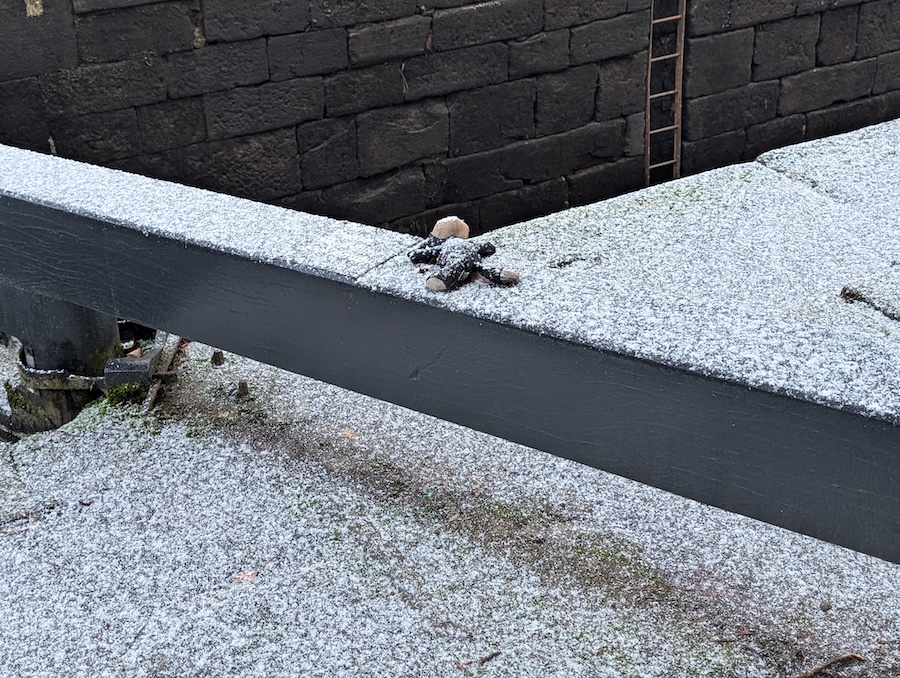
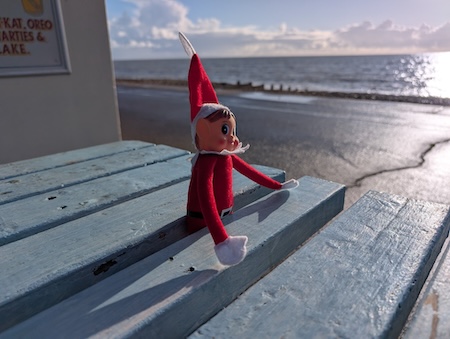
Abandoned snitch elf
Exercise continued to be neglected, and I added a couple of pounds to my current weight. The lack of movement has left me feeling sluggish, achy and heavy. Something to deal with in 2026.
It was another slow month with writing. I’ve struggled to find energy and was not clear-headed enough at times. Mostly, I’ve been removing obstacles and obligations, ready for the new year. I finished a draft of the Mycelium Parish News and need to see what happens next with that. The writing highlight was an excellent workshop at Inaland gallery, which gave me lots of ideas. People were also reading the advent calendar, which was fun – although we perhaps went harder than people would have liked with the final image.
Art show at inaland where pieces were sold from the wall
The pause in work allowed me to get back into reading. I read a brace of Jarett Kobek books – Atta was superb, but the Zodiac true crime duology felt less compelling. I read a dreadful 19290s pulp novel for the dystopian book club. I caught up with David Lapham’s comic book crime saga Stray Bullets. The best book I read was When We Were Real, set in a world seven years after everyone learned it was a simulation. A lighter read was a fesshole compilation, which made me laugh so much that I couldn’t read it on the train.
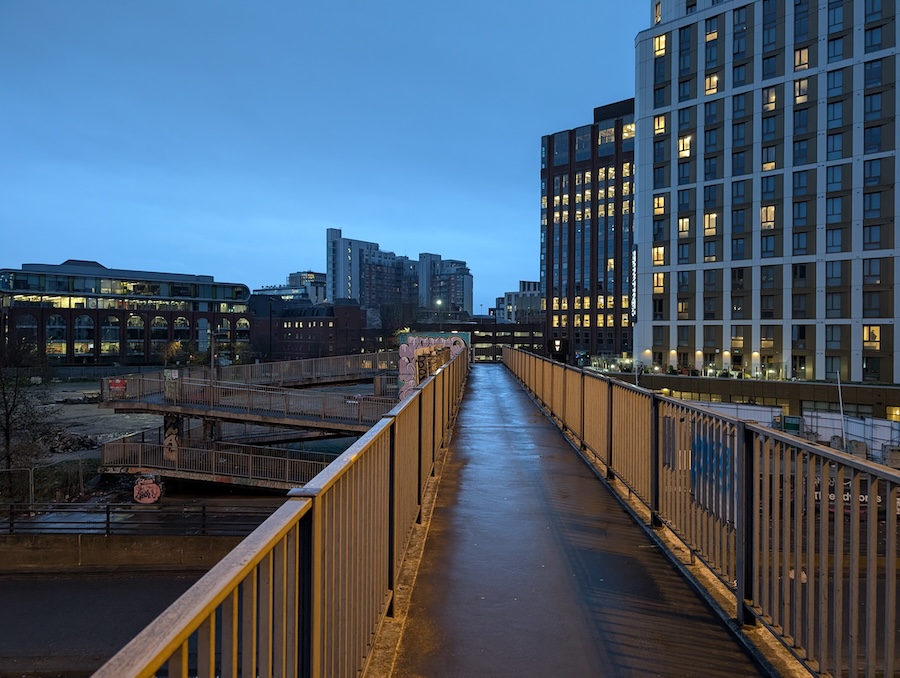
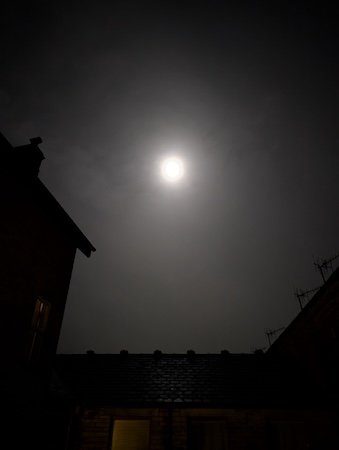
Dawn in Leeds
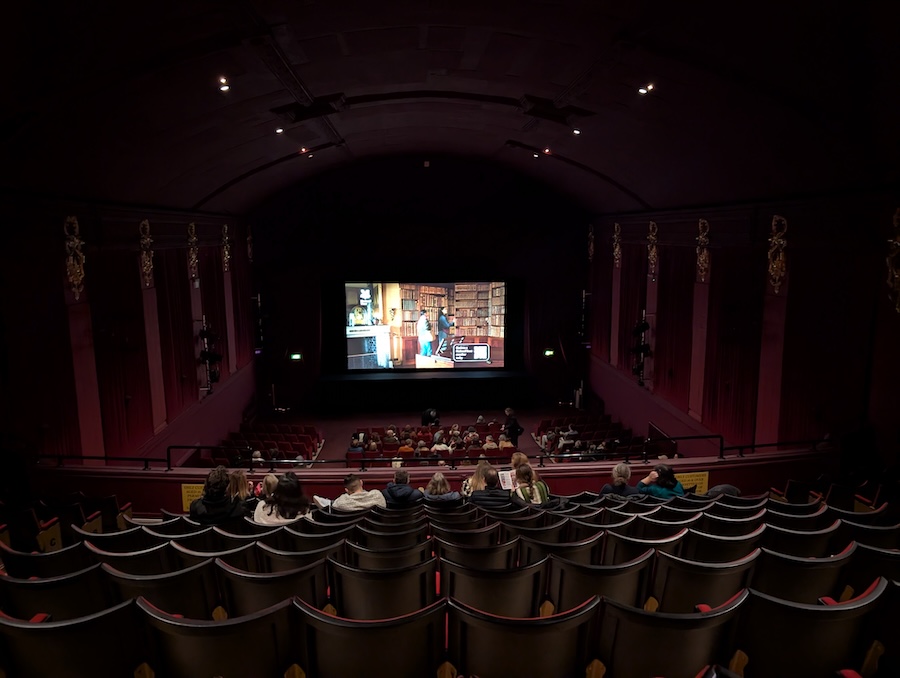
Despite an excellent programme at the Picturehouse, I made no trips to the cinema until Christmas Eve. The films I watched at home were mostly Christmas ones, and mostly disappointing. Kanye West documentary In Whose Name? was more interesting for its content rather than its form but was compulsive viewing. I disliked It was Just an Accident, which made me feel bad considering what the director went through. My favourite watch of the month was My Cousin Vinny – I loved the relationship between the main characters.
After not liking the first episode, I enjoyed the rest of the season of Pluribus. Taylor Swift puff-piece End of an Eras turned out to be compelling competence porn. Spartacus: House of Ashur is shameless pulp, but it has the same delight in language that Deadwood had. The Chair Company didn’t take on a first attempt, but I want to try it again.
I’ve talked about the stress of work, but it’s also gone well. I enjoyed the office party, which is a good sign. I was given an award for my contributions during the year, which was a wonderful surprise. The break gave me a little time to play with technology – I worked on an MCP demo which I’ll hopefully show at our Java group, and accidentally vibe coded an Obsidian plugin when I should have been doing something else.
The main reason I’m enjoying work is much is probably post-pandemic working. Not having to travel to an office five days a week is much less tiring. I only have one mandatory office day a week, with my client, but I usually visit my home office most weeks. This feels like a good balance.
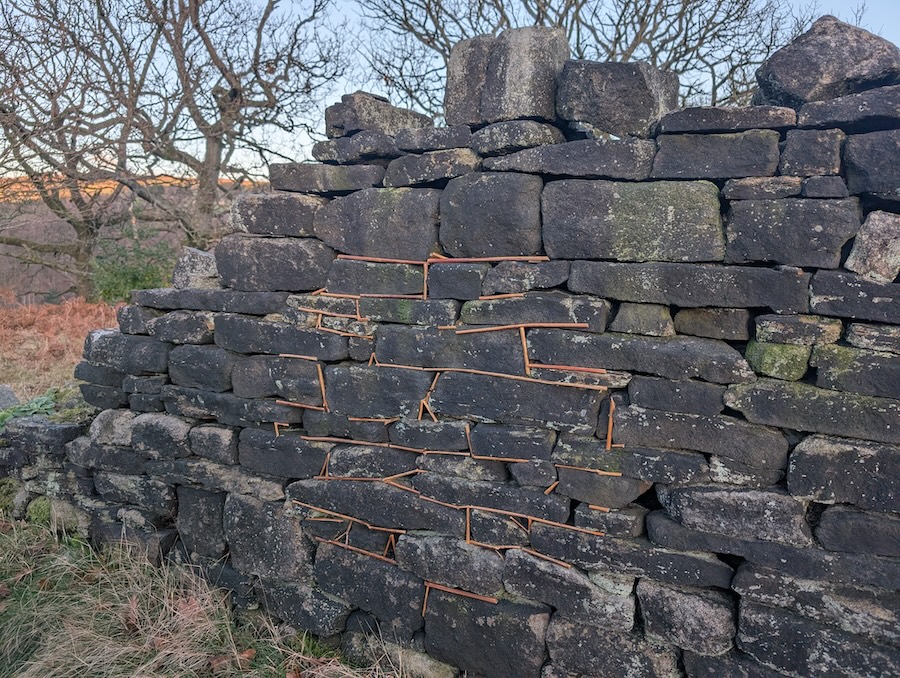
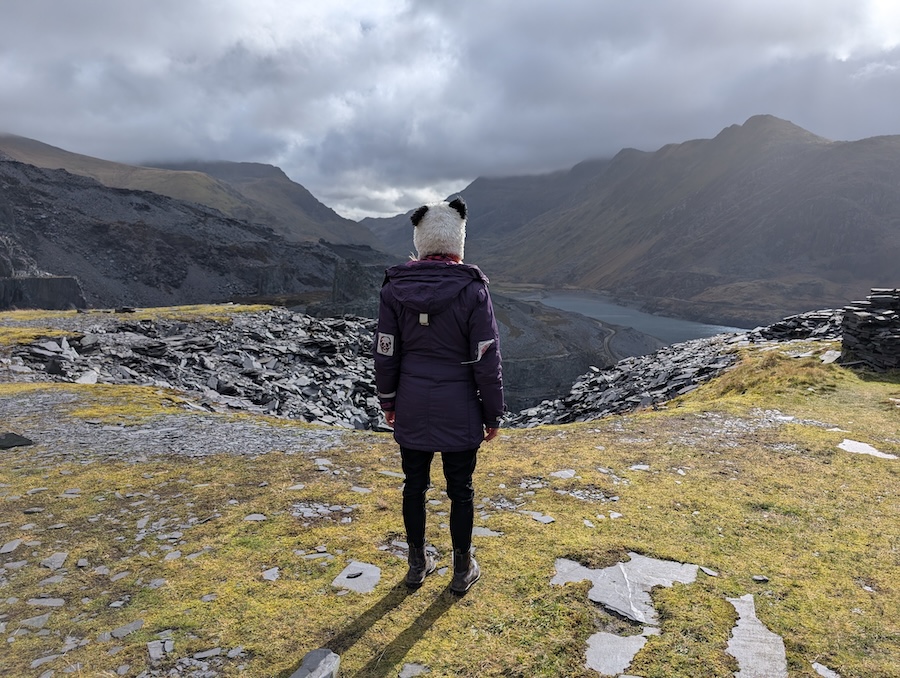
Land art near the quarry
I took the opportunity offered by the Christmas break to clear some things out. I closed my mastodon account as that was proving to be more of a distraction than a joy. I’ve still not shut down the substack newsletter, but I’m now a paid-up user of Buttondown. I’m also getting closer to deleting my WhatsApp account.
In previous years, I’ve set resolutions. This year, someone suggested picking a single word – and the word I’ve chosen is ‘flow’. Having a single work makes more sense than a series of goals that inevitably includes ‘start running again’ like every other year.
Flow to me means removing the stagnation in my life. My impressions of 2025 were overwhelm and inertia. I was caught up in several unhelpful, repeating patterns. By increasing flow I can fix a number of issues – lack of exercise, distractions online, dissatisfaction with my writing. I can deal with the clutter in my life – virtual and physical.
I do need to get out of the house more. The pandemic was great for me, in that it removed the need to head to an office five days a week. But I also got out of practise with going out in general (not helped by giving up alcohol a few years back – I feel healthier for stopping, but I miss the energy of drunken nights out). Interestingly, this need to get out more was one of the themes that emerged in a tarot reading that I had a couple of days ago.
2026 is also the year that I turn 50. As a teenager, this seemed impossibly old but now I’m almost there. I think it’s important not to define or limit myself by my age, while making sure to draw the benefits from it. Sometimes, being this old excites me, other times it fills me with dread about all the wasted time in the past.
There are several things I still want to do in my life. I’d better hurry up and get on with them.
2025 was hard work, on the whole. One of the benefits of keeping my monthnotes is that I can look back at trends. It turns out that I’ve felt overworked and overwhelmed pretty much throughout the year – not just in the past few months, as I’d thought. That’s something I need to fix as soon as possible.
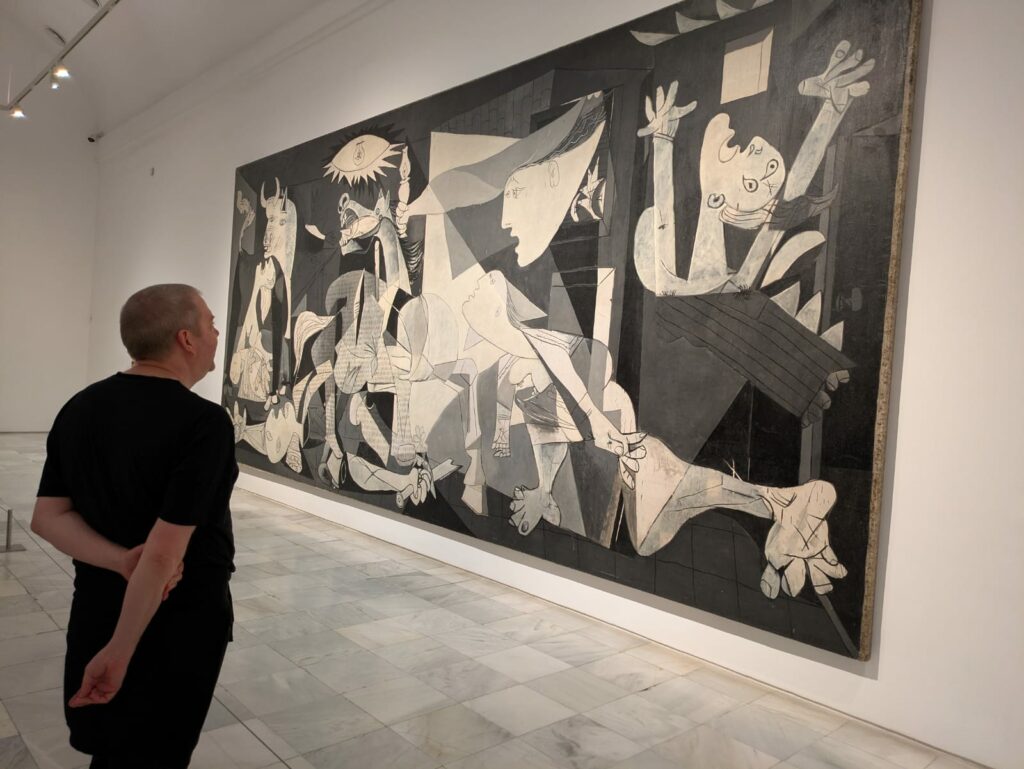
There were some great highlights to the year: seeing Guernica in Madrid and the Goldsworthy retrospective in Edinburgh. Rosy moved up to Hebden Bridge. Kitty and John got married. Sinners was an amazing movie. I did my first public tarot readings. I performed at a wonderful event in the Brighton Fringe and had my first reading in Hebden Bridge.
Work has gone well. I’m more than three years into this job and still love it. The pandemic has helped with this – permanent office attendance ground me down in all my other jobs. Having more energy has meant I’ve engaged more with my colleagues. My role is challenging but I’m excited about going into 2026.
I’ve struggled with my writing a little, with work stealing much of the energy that I need for that. I’ve wound up the weekly substack and I’m looking into how I can bring a new energy into whatever I produce. I also want to concentrate more on writing that involves real-world interactions.
I’m ending 2025 far more tired than I should feel. It was a good year, but I want next year to be better.
Despite everything, I read 78 books in 2025, about 20 more than last year. Not all of these were good – I still struggle with my primary school teaching about how you should always finish a book once you’ve started. Still, there were a lot of great books to choose from for my top ten this year. As usual, these are ordered alphabetically.
Max S Bennett’s A Brief History of Intelligence was a gift and I would not have read it otherwise – I grew bored of pop-science after uni. But this is one of those rare books that changes the way you look at the world forever. Bennett uses the latest neuroscience to show how intelligence has evolved on earth, and how human brains contain the remnants of simpler systems; and, in passing, the reason for dreams and fiction are explained. Great stuff.
We had two books from John Higgs this year. My favourite was Exerminate! Regenerate! (blogged here), which had a little more space for exploring its subject. Writing about Doctor Who risks being fan service, but Higgs explored the nature of storytelling, as well as telling some great anecdotes about the show.
I originally heard about Miranda July’s All Foursvia Sara Crowley’s blog. It’s not a perfect novel – too didactic in places, and sometimes blind to the main character’s privilege – but it’s also a book that’s been read by a lot of people I know, something I’ve not encountered in a long while.
Another excellent horror novel was I Want To Go Home But I’m Already There by Róisín Lanigan. I think we expected more haunted houses from the housing crisis, but this does the job perfectly. The iniquities of renting a home are almost more unsettling than the ghosts in this debut novel. I’m hoping Lanigan’s next book is also horror.
There have been a number of good books on folk customs over the year, but Lally MacBeth’s The Lost Folk stood out. MacBeth has a wide definition of folk, including church kneelers and cake-making, and the book ends with a rousing call about the importance of inclusion in folk.
Joseph Matheny is justly famous for Ong’s Hat, but the conspiracy aspects often overwhelm the literary ones. Matheny’s Ong’s Hat Compleat talks about all aspects of the experiment, including the building of an early language model. The form of the book is also experimental, being released as a parallel text and audiobook that explore different parts of the experiment.
Alison Rumfitt’s Brainwyrms is a deeply troubling and problematic book. It’s very much extreme horror and therefore not for everyone. But Rumfitt is an excellent writer, and this is one of the best horror novels I’ve read. Her first novel, Tell Me I’m Worthless would also have been a perfect addition to this list. She is very much on the list of writers I’ll pre-order.
Ultra-Processed People by Chris van Tulleken (blogged here) is a polemic about modern food production and its dangers. van Tulleken’s writing is lurid and comes close to body horror at times.
The White Pube’s Poor Artists was picked up at Todmorden books. It was a well-written, provocative and empathic book about the struggles of artists within today’s society, as well as a polemic in favour of making art.
Careless People is a gossipy book about Sarah Wynn-Williams’ time working at Facebook. It’s also a worrying portrait of the flawed and unpleasant people who have been placed in charge of our world.
Every year, I write a post looking back on my writing over the past year. There are entries for 2024, 2023, and 2022. I was a little unexcited about doing one for 2025 as I’ve struggled with the flow of my writing this year – which I guess says something significant. Work has taken a lot of my energy and my writing finds it hard to compete.
It’s not been a bad year in terms of what I produced. I sent out a second horror advent calendar, had a poem in a poetry trail, and published a piece in Bryony Good’s In a Land zine. I also published a lot of stories that I was happy with:
But I’ve also felt frustrated. I’ve been questioning for a couple of years whether the writing is worth the effort I put into it. I love my job more than ever before and the writing takes up creative energy that could go into that. This was less of a problem when I had jobs I hated. The ideal answer is raise my writing game so it’s as satisfying as my job.
The interesting things about the stories that I listed above is that they were all written quickly, and most of them to theme. A lot of my being bogged down comes from trying to plan my writing rather than letting it emerge. So, 2026 is going to be very different. I’m going to prioritise having fun.
I stopped doing the weekly substack email as it had begun to feel like a chore. I’ve moved across to buttondown and will be sending some new things through that. But it will be an irregular thing, waiting for when I have something to share.
My big goal is to have more engagement between my writing and the physical world. I need to prioritise attending workshops and writing groups. I want to produce more physical objects and postal projects. I’d also love to do some collaborations – there are people I know who I’d love to work with, including SHIELDS, Francesca Cluney, Kitty Peels, The Indelicates, Lou Ice and DRPFD. Let’s see what the next year brings.
I also want to produce larger-scale work. I’ve spent 20 years obsessed with large texts composed of fragments. I want to do something with that idea.
The main reason was wanting to remove an attention sink, one less app that I might refresh to look for stimulation. While I love the concept of microblogging, and the existence of the fediverse, it was not working for me.
There were a few specific issues with Mastodon itself:
The protocol ties any content to the domain name it’s produced under. This means it is impossible to properly migrate posts to another account. I was not aware of this when I signed up, and it’s a fairly significant constraint.
The existence of an algorithmic ‘trending’ feed encouraged people to write content to appeal to an audience. I’d come to Mastodon to avoid that sort of karma-farming.
While I love microblogging, I hadn’t managed to build a large enough community. Looks like everyone went to Bluesky, and I’m not going near another VC-funded algorithmic system.
Rob Shearer gives a more detailed breakdown on some of the issues in his Mastodon Exit Interview.
I’m looking forward to getting back to blogging – and wordpress can now link to the fediverse as well.
Earlier this year I looked back at my old blog posts and I miss using it for more developed thoughts that I’d write on twitter/Bluesky/mastodon. Blogging and its RSS framework already provide most of what I actually want from the fediverse.