On microfiction

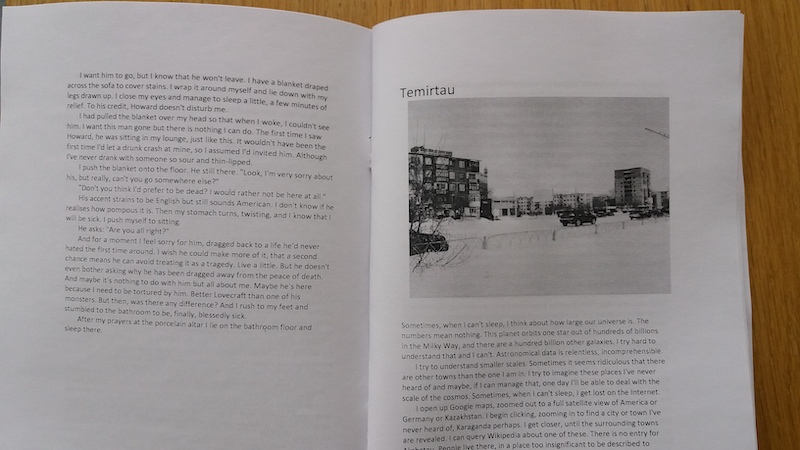
In April, I’m running a writing workshop on horror microfiction. It’s been a long time since I’ve taught a workshop rather than simply facilitated a writing session. I’ve been thinking a lot about tiny stories over the years and it will be good to crystallise my thoughts on the topic – starting with some notes on this blog.

Why write microfiction

  • I think my love of microfiction comes from reading comic books, and how the captions would sometimes refer to other stories, firing up my imagination. A lot of the books I loved best as a teenager intentionally played with this.
  • I always found these hints more interesting than what was later set as canon. Franchise fiction will introduce mysterious characters and eventually fill in the backstories, and something is lost.
  • I think the same sort of references work in horror – the hints of something awful happening are often worse than what can be depicted onscreen. There’s a power to creating a gap for other people to fill in.
  • I can’t be sure that these gaps are something that everyone loves – maybe some people prefer stories to be defined and complete. But, for me, I like ambiguities and mysteries.

Baby Shoes

  • A lot of people have come up with theories about what a ‘story’ is. Generally, a story will include characters going through some sort of event, with a beginning, middle and end.
  • But this is not true of every story – for example, Baby Shoes. This is the archetypal tiny story, but it works as a piece of found text. The three two-word sentences reveal an event that has already happened – and the change in the story is in our understanding of what we are seeing.
    • For Sale – tells us this is some sort of advertisement.
    • Baby Shoes – introduces the characters by implication, a parent and a child.
    • Never Worn – a twist in the tale, leaving us to realise why these shoes are good-as-new.
  • This story is often attributed to Hemingway, but versions of it date back to 1906, and the attribution seems to have come from 1989 (both facts according to Wikipedia).
  • This inspired the six-word memoirs project

Technique

  • The most important thing about writing tiny stories is that they are stories rather than descriptions of a story. It’s easy to fall into this trap. Rosy has rejected quite a few advent calendar stories on that basis.
  • You can see this in a lot of collections of six word stories. A lot of them feel glib – there’s not enough space for the pathos these aim for.
  • You can only cut back a story a certain amount. You need some sort of change for a story, otherwise it becomes a description.

Future Plans?

  • I’ve always wanted to write a novel from fragments. It’s something I’ve played with, but never tried as seriously as I should have done. My professor for my MA, Nicholas Royle, asserted you could not make a novel from vignettes, but I am convinced that you can.
  • I think I’m going to make some prototypes then give this a proper try. I suspect very few people would read any novel I write but, at the moment, I’m more interested in questions of craft than audience.
Other links

A new feed for my audio content

I have set up a new site, audio.orbific.com, which contains a feed for audio recordings. Basically, it’s a podcast, but without the consistency people expect from podcasts nowadays. It will contain stories, voice messages, field recordings, interviews and so on. The first couple of recordings are up. You can follow them there, or watch here for mentions of significant ones.

The first recording is a simple voice message:

The site contains more details, as well as pages for other content.

I want to spend the rest of this post talking about the technical details of setting up a podcast. One of the joys about podcasting when it first emerged around 2004 was that it was a clever hack, built on the RSS file format, enabling people to automatically download files onto an iPod. It’s worth reading Warren Ellis’s evangelical 2004 piece where he tries explaining why this is important. About 15 years later, podcasts are now huge, with Spotify signing a reported $100 million deal with Joe Rogan – but it’s taken a long, long time to reach that point.

One of the initial attractions of podcasting was its grass roots nature. They were made by hobbyists, and there was little way of capturing analytics to sell advertising. Now there are various platforms available which will set up a podcast. Some of these are free, but make their money from advertising (such as Spotify’s anchor platform); others take a fee for hosting.

Setting up a podcast is now easy, compared to the instructions in Ellis’s 2004 piece. But I faced three main issues:

  • I wanted to maintain control of feed’s address on a domain I owned.
  • I didn’t want to pay large monthly fees for hosting the podcast
  • I didn’t want to be part of a surveillance mechanism designed to sell advertising.

I considered a WordPress plugin, but that was a little more complicated than I wanted. In the end, the ideal set up was a Jeckyll static site with audio files hosted on Amazon S3. There was a template for this on GitHub that I could adapt. In the end, it took me a couple of hours to get working, and was relatively simple, although the work would be too much hassle for a lot of people:

  • I needed to fork a GitHub project. The GitHub tools means the site can be directly edited on the web without knowing about git, so it was not as hard as it might have been
  • The post files are edited in markdown
  • I had to edit the DNS for my domain to create a subdomain, and then point that to Github pages
  • I am using Amazon’s S3 to store the files. Setting this up was a drag, involving lots of forbidding warnings about making S3 buckets public.
  • I set up a Plausible analytics script to track visit. This was something I heard about from James Stanier, and allows site users to be logged without infringing their privacy (it doesn’t even require a GDPR opt-in).

If, after reading the above, you’re interested in doing something similar and want my help, get in touch. For me, the most difficult bit was finding the toolset I needed. That, and dealing with Amazon Web Services configuration, but that bit would be easy to swap out.

Microfiction collection: Days and Nights in W12 by Jack Robinson

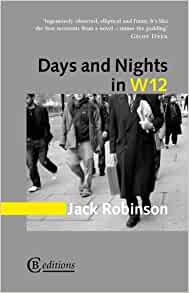
I’d not heard of Jack Robinson before Tim Blackwell sent me a copy of his book Days and Nights in W12. It’s a stunning collection.

I love works made up of micro fictions. There are some great examples of this, such as David Eagleman’s book Sum, Einstein’s Dreams by Alan Lightman or Sarah Salway’s Something Beginning With. It’s tricky to get right, since it’s easy to sound glib with such short stories.

Robinson’s book consists of stories responding to photographs of W12. Obviously, I love this because the combination of text and pictures is what we do in the Not for the Faint-Hearted workshop. Robinson has some outrageous tall tales, doing a great job of describing and enchanting the city. You might describe this as a work of psychogeography, if we still used that word.

But it’s even better than that! It has an index. There aren’t enough works of fiction with indexes (JG Ballard once wrote a short story in the form of an index in his collection War Fever and it’s one of the best short stories ever). Robinson has cross-references between the stories too, recalling Geoff Ryman’s book ‘Internet novel’ 253.

I’d always loved the idea of writing microfictions about Brighton. But this book describes London so well that I don’t think I could write such stories about an urban area anything like as well.

As if there was no enough to love about this book already, Jack Robinson is a pseudonym. Tim pointed me towards an interview with the actual writer, Charles Boyle. He runs CB Editions, Robinson’s publisher, and there are several other writers on the list that are also Boyle’s alter-ego.

I can’t believe I hadn’t read Robinson before. These sort of discoveries are so exciting, as they suggest the possibility of other equally-thrilling books waiting somewhere for you. And I was so sure that the Glass Hotel would be my book of the year.

Lovecraft in Brighton

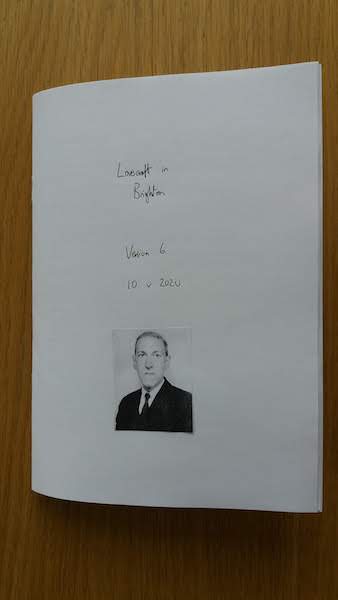
For the last six months I’ve been working on my South Downs Way project, a large project made out of short stories. It’s not the only such project I have ongoing. Since 2014, I’ve been working on a slow-burning project called Lovecraft in Brighton. It’s a collection about an alcoholic who is haunted by the ghost of HP Lovecraft: basically Kitchen-Sink Cosmic Horror.

The booklet has been for sale on my online store. Every time someone buys a copy, I write a new story and the price goes up by 10p. When I finish the volume, it will be compiled into an e-book and sent to all the people who have bought it.

As bad as I am at self-promotion, people rarely see the store and buy a copy. But someone recently bought one so I had to write a new horror story. Which took ages. Writing doomy horror is a lot less fun in the current situation.

I’ve taken it off sale for the time being, but will re-add it when I feel more in the mood. This is a long-running project, and I am alright with that. Once I’ve done a few more volumes of the South Downs Way I will put it back on sale. At this rate, I will probably finish this in my 50s. And that’s OK.

Tour Guide

My friend Amy spent six days working as a tour guide before being fired. I sneaked onto a couple of her tours and loved them.

She’d passed the interview without knowing much local history. She made things up instead, pointing out the park where circus performers wintered; she would praise the annual cake-making competitions in the Pavilion. She told people bus conductors were first introduced in Brighton and were so-named because they led the passengers in communal sing-songs.

Amy didn’t last long. The night she was fired, I toasted her work, but it didn’t cheer her up. “Can’t they see that my version of the city was better?”