Kanye vs Bowie

When I tell people that Kanye West is this era’s Bowie, I’m not trolling. Or, at least, I’m not just trolling. I honestly believe that Kanye West is one of the most interesting artists working today.

Of course, any such comparison is disgusting. Why should one artist be pitted against another? It’s wrong to try scoring such individual careers against each other. But the comparison does have one positive, in trying to stop people from dismissing Kanye as untalented or mad, while Bowie is uncritically considered as a genius.

Bowie took some great risks. He was mocked for Tin Machine and his early love of the Internet, but he took those steps regardless of the response. The music press was cruel about Bowie’s experiments with jungle, as if they wanted more of the same, year after year. And the whole reason we remember Bowie is that he was controversial – that moment, now so overdetermined, on Top of the Pops – most people who hate on Kanye now would probably have been hating on Bowie back then. You know: he’s not great like the Beatles or Elvis, is he?

Kanye is brash and provocative, but there’s a lot of thought to it. I mean, that New York Times interview where he compared himself to Steve Jobs was an exquisitely targeted provocation. Then there was releasing Yeezus, an abrasive nasty album with no hooks when he had the world’s attention. I mean just check out Lou Reed’s Guardian review of Yeezus: “No one’s near doing what he’s doing, it’s not even on the same planet.”

Kanye attended art school before dropping out to become a producer – and a massively successful one. That work alone assured his place in rap history, before he made his own tracks. People might mock the fashion work, but Kanye has put in the time, moving to Rome to intern with an Italian brand. West is constantly experimenting and playing. Not all of it works, but hey – Bowie had Dancing in the Streets and the Laughing Gnome.

People want that hit that’s as easy as Space Oddity: the three minute track that explains the artist. Whatever. Kanye West is a fascinating artist and there’s a lot to look at. If you don’t want to engage with it, fine, but don’t assume that makes the work worthless.

If you are looking for an interesting starting point, there’s this ten minute video on The Voice as Instrument, which I love. And there’s an entire podcast series on My beautiful dark twisted fantasy, which I really need to listen to.

Famous for 15 People

Famous for 15 People is an ebook of my writing. It came out last year, but I’m only now getting around to officially launching it, with an event at Brighton’s Regency Town House on March 15th.

I’ve described Famous for 15 People as a ‘mixtape’ rather than a collection, mainly because it doesn’t have the overall theme that a collection would. Instead, it collects a range of different writing I’ve done over the years. It’s a very mixed book, but I love all of these pieces.

The book contains a number of short stories that I’ve performed over the years: such as meat a story about vegetarian kink; or We have always lived in the Slaughterhouse, about a family forced to hide from abuse. There’s a story about Kurt Cobain and the clown-horror Death of a Ronald. One of my favourite pieces to perform is about ventriloquism, A bad place to stick your hand.

There’s also a few examples of microfiction, which I count as being stories under 300 words, preferably under 200. I’ve done a lot of this over the years through my workshop event, Not For The Faint-hearted. I’d love to do a collection solely of microfiction, but in the meantime I’ve collected some published and unpublished pieces here including Vole, Pinnochio and The Saddest Dogs in the World.

Then are the horror stories. I’ve written before about my love of horror fiction. I’ve become much more comfortable with working in this genre over time. One of the pieces in the book, In the Night Supermarket, was part of a magazine competition to find exciting new horror writers; I wish I’d followed up on that more. Death of a Ronald certainly counts as horror, and there’s also Eat at Lovecraft’s – a story I love, but one that frustrates me as I’ve no idea where it came from. Some of the horror pieces comes from my project Lovecraft in Brighton, a weird book that adds a new story with each copy sold, something I hope will begin moving again soon.

There are also a couple of pieces of non-fiction, one of them a history of vindaloo, the other a commission I withdrew about Britpop, memory and nostalgia.

It’s a wide range of pieces, all tied together by an introduction from Rosy Carrick. I’m proud of each of these pieces and it’s good to finally give them a home.

Book launch: Famous for 15 People

On March 15th 2018, I’m holding a Brighton launch for my ebook, Famous for 15 People. It takes place at Brighton’s Regency Town House, and features performances from me, Rosy Carrick and Chris Parkinson. Tickets are available online and cost a mere £4. There’s even a bar at the venue.

Many of the stories had their origin on the Sussex university creative writing MA, where I first met Chris and Rosy. I’ll perform a couple of regular pieces, as well as some multi-media performances that I’ve only done once before. There will also be some microfictions; and I’m going to talk a little about why ebooks are so exciting as a way for people to share their writing.

I describe Famous… as a ‘mixtape’. It contains short stories (some very short!) and non-fiction written over the last ten years. The title comes from a quote from the artist Momus that I love. I’m pleased to have made a home for all these stories.

The book actually came out in May last year, but I got distracted by work and other events, so the launch never happened. I am the worst self-promoter ever – as you can also tell by the fact I’ve got multimedia performances I loved that have only been performed once.

Do come! Tickets are £4, and the book can be downloaded from Amazon. And if you do get a copy from Amazon, please leave a review!

Fire and Fury

I’m loving the Fire and the Fury. Wollf’s book feels like a DeLillo novel, with its portrait of a property tycoon who accidentally becomes president. The hubris of it all is incredible, as is the portrait of a man who exists only through media. “He was postliterate – total television”.

Obviously, all the best bits are in the excerpts you’ve already read, but the novel itself is stunning.

– “What is this ‘white trash’?” asked the model
“They’re people just like me,” said Trump. “Only they’re poor”

The concept is a far-fetched in places, but once you suspend your disbelief it’s enthralling. I’m only a quarter of the way through, but I fear for the nuclear tragedy the author is setting up.

Basically, our universe has been invaded by a fiction.

(originally posted on facebook)

Cooking a Simple Curry

The simplest curry I’ve ever eaten was during a camel safari near Jaisalmer. Made over a fire of twigs and branches, the plates were cleaned by scouring with sand afterwards. And it tasted pretty good. But what is the simplest curry I can cook?

When you’re a terrible cook, people like to give you cookbooks as presents. It’s as if the right combination of words are going to make up for lack of experience. A lot of these presents were potentially deadly – given the disasters I’ve produced, why give me a book whose recipes involve cooking things in pans of deep oil? It’s one thing to produce an inedible meal with a cooking disaster, quite another to need skin grafts.

Student cookbooks are the lowest form of cookbook. These are aimed at people who have never cooked. The ones I have date back to the days when students arrived at university with a new set of pans from Woolworths. They are aimed at people who have no idea what they are doing, and would rather be in a bar. The only simpler recipes you’ll find for a curry are ready meal instructions. They are almost a joke – unless you know very little about cooking, in which case they’re a lifeline.

I won’t name the cookbook I’m using, but the edition I’ve got comes from 1997. Its recipe for ‘Vegetable Curry’ fills me with suspicion for its simplicity as well as its enthusiasm for fruit. The ingredients include a huge amount of coconut, something I’m not a huge fan of, and the introduction suggests the use of “slices of banana and apple as a tasty side dish“. There’s a whole post to be written sometime about the English and Australian obsession for linking fruit and curry.

The recipe uses potato, onion, cauliflower and carrot as the vegetables. The curry-ness is provided by a tablespoon of curry powder at the start. While the ingredients are all ones you might find in a takeaway curry, I think they’d need a little more excitement to make something of them. This is basically a stew with a sprinkle of curry flavour.

More than anything, this dish is reminiscent of the one I was served at ‘Slices of Balti’ a few months back. It tastes a little better, because I’m capable of not cooking vegetables until all texture is destroyed. But it’s still bland. This is what vegetarianism used to be like, when the mockery of meat-eaters was a little more justified. Look at this picture, to get an idea of how joyless this recipe turned out to be:

Taking this photo, I realised that it’s more difficult than I thought to take decent photos of food at home. I guess the lighting in restaurants is better for this. I know I did a half decent job, solely because some of the photos I took are much, much worse:

That’s the simplest curry recipe I can find on my bookshelves. It’s interesting to compare to what I’d normally make: I can do much better.

What’s the best curry house in Brighton?

Picking the best curry house in Brighton is not easy. It’s also more difficult for me after a couple of restaurants closed.

Two favourite places recently vanished from Preston Street. The Bombay, down at the sea end, used to be my go-to place for a straightforward British curry. Nothing flash, but a decent, consistent meal – consistency being one of the big problems with curry houses. More recently, the Nishat Tandoori closed for renovations (or relocation, according to the website). I’m hoping this is indeed the case, and it’s not one of those situations where shut ‘temporarily’ and never re-open.

The Nishat was great because the regular curry menu was combined with various Goan options. They did a good Xacuti and an excellent Goan-style vindaloo. Instead of assaulting you with chilli, it was done in the vinegary Goan style. They also had the regular dishes you’d expect from a British curry house. It was always fun mixing Goan- and British-style curry dishes.

The Curry Leaf Cafe gets a lot of respect, but that is on probation after managing to serve a hunk of lamb in my vegetable Thali. They did offer a free tea and coffee to apologise, but that isn’t much use when you’re on a lunch break and don’t have time to linger anyhow. I’m sure I’ll go back, but it’s taking me a while to feel comfortable about the idea.

Some of those who know me are probably wondering why I’m not listing Planet India as my favourite curry house. I love Planet India. It has by far the best menu I’ve ever read, with a brief commentary on each of the dishes – a simple touch that always made me feel at home.

But I don’t consider Planet India a curry house, as it aims to provide more ‘authentic’ Indian dishes than the British-Indian places usually offer. It’s a great place for a treat, but not what I’m after for a standard takeaway curry.

With Nishat gone, I have a few go-to places. There’s the Raj Pavilion or the Shahi, which I know from when I used to live that side of town. My nearest restaurant if the Ashoka, which is pretty good. But right now, I don’t have a strong favourite. So what is the best curry house in Brighton?


The Horrors of the Beach Planner

My day job involves managing projects across several countries, and this means fiendishly complicated documents. Booking a trip to Goa for later this year seemed like the perfect way to unwind. But, reading the Lonely Planet guide to Goa, I encountered a document more disturbing than the schedules I’ve been reading:

Goa is famous for its attitude of susegad. This is said to be a national mood of laid-back, easy-going hospitality and tolerance, which apparently comes from the Portuguese word sossegado, meaning silence. The idea of susegad might well be linked to colonialist ideas of Goa, it’s still something used to sell the state to tourists, even as deserted beaches become bustling resorts.

Goa promises miles of relaxing beaches. but the idea of a Beach Planner just makes me nervous. For a start, there’s that introduction talking about how that Goa’s “tropical island” feel means “it’s easy to forget that you’re in India“. I’m not sure why this should be something that improves your holiday.

The section then goes on to categorise the beaches.I booked to stay in Mandrem (Relaxing with a Good Book) last year, when I meant to book a place in Arambol (Backpackers and Budget Travellers). It worked out OK, as Mandrem seemed to suit me better than Arambol would (although I was robbed on the price of the hotel room).

The categories for the beaches sound OK: Water Sports; Family Fun; Partying and Drinking; Yoga and Spirituality (including both Mandrem and Arambol); Five Star Treatment; Nature; and Beach Huts (Mandrem, again).

But there’s something aggressively organised about this planner. I imagine it being reduced to a diagram, a series of intersecting circles, which must be navigated to get your holiday right. Apparently “the decision shouldn’t be made on just the aesthetics of sand and sea: it’s about choosing the beach community that suits your style of travel and sense of place.” This is very much the sort of decision I booked a holiday to get away from.

The book is firm on the importance of the right place: “Locating the perfect beach is the secret to making the most of your stay“. Getting the wrong beach will ruin the everything. The choice of beach feels like destiny, as great a challenge as if I was forced to choose my own star sign.

But two things reassure me – the first is that the LP has not bothered to classify every beach, missing out, for example, quiet Querim. I hiked through here on the way to Fort Tiracol, a tiny fort on the very Northern edge of Goa. It was small and peaceful and empty, although much of the beach was too steep for easy swimming.

And, secondly, the Beach Planner itself ends on a reassuring note: “Goa is small enough that you can jump on a scooter or in a taxi and explore.” You don’t have to stay anywhere you don’t want to. So I’m thinking of getting a taxi to the very south of the island, and working my way up. There are other ways to find beaches than a Beach Planner.

How to distribute a zine

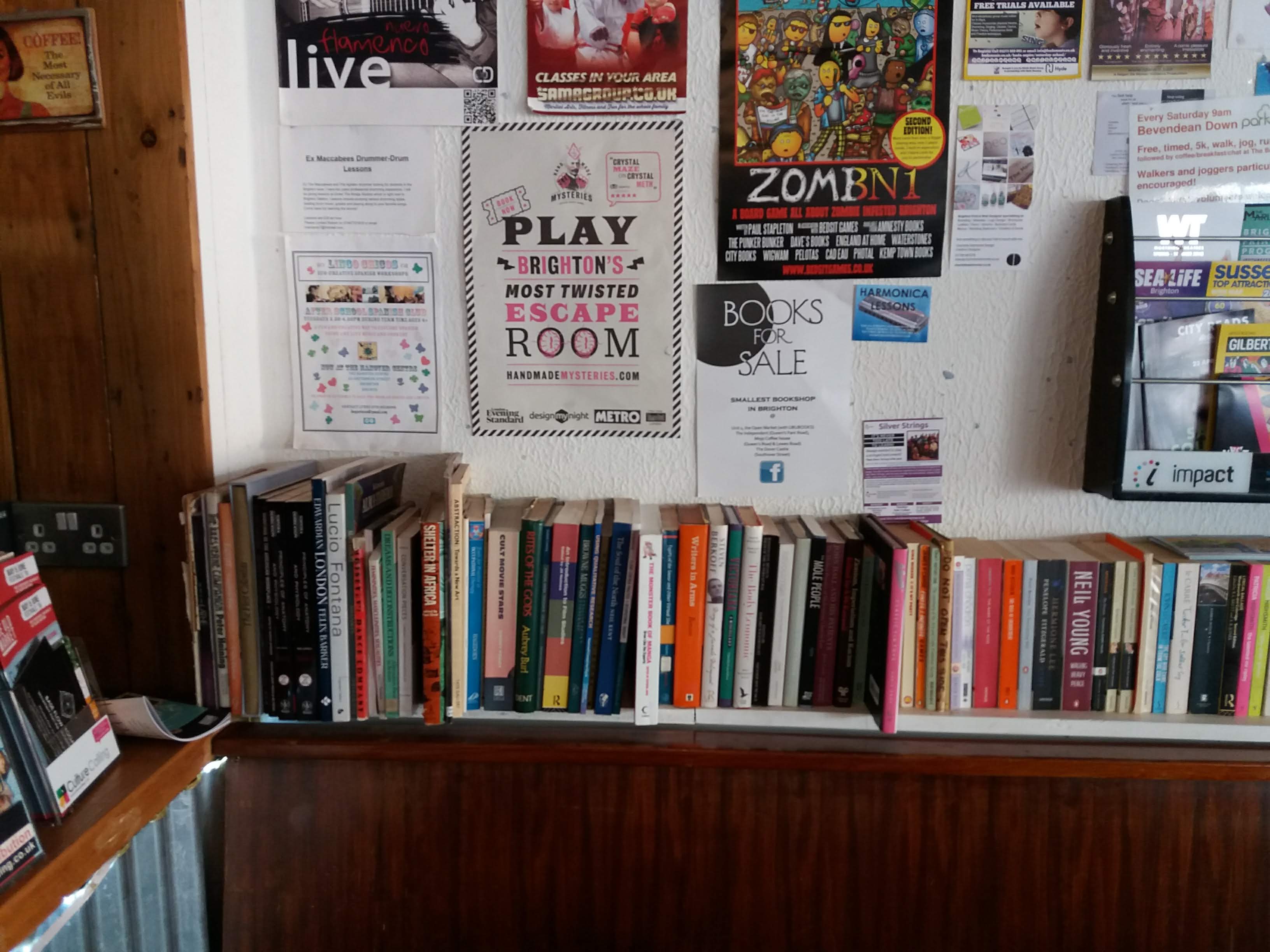
I don’t normally take Brighton busses, but I was running late. I’d had to pick up a parcel then head into town, so I was waiting for the number 7 near Hove station. Bored, I spotted something odd in a box of leaflets. At first I thought someone had sneaked in a flyer.

Moving a little closer, I saw it was a zine. So I picked it up and read it.

This is the sort of thing I love about zines. You certainly don’t get this from a website. You don’t find websites carefully hidden when you’re wandering away from your usual routes.

Secret Desires is by Cynical Elliot, and the cover features “the bloke from Keane”. Now, there’s a band I’ve not thought about in years. I’ve listened to their records in the past, but can’t recall the names of any songs without checking Wikipedia.

The zine features portraits of various musicians, and invites us to “leave our musical prejudices at the door”. Now, I’m giving no quarter on my dislike of Jamiroquai’s music, but Dolly Parton I do have time for. And Bananarama.

Finding this on the way to work was a Good Thing. I love the idea of media that’s not tied to clicks and referrers, but is distributed by leaving it somewhere. Maybe there should be more of this sort of thing. (Maybe I should be doing this sort of thing?). Media like messages in bottles.

Final Day on the Ridgeway

I’ve walked three complete trails this year: North Downs, Limestone and Ridgeway. In each of these cases, the ending of the trail has been a strange experience. Given all the work that goes into promoting and maintaining these routes, I’m surprised more thought doesn’t go into the ends.

Walking the Ridgeway against the grain, from Aylesbury to Avebury, meant a more exciting destination, but a less impressive final stage. Much of day five was open countryside and tame scenery – but it was good to spend a night in Avebury, a short distance from the stone circle.

The final day began with a boring stretch of roadway. The weather was cloudy which was a relief after four days of harsh sun.

As usual there were strange sights along the way. The sign on the tree shown below read “Christmas is the warm, happy ending to our family’s story each year”

The endings of these hikes often feel odd. You’ve achieved something, but often the only marker of the trail’s end is a signpost pointing in only one direction

Avebury is a fascinating place to visit, with some incredible ancient sites. As it was mid-Summer, the hill up to Kennet Long-Barrow was covered in golden corn. I somehow missed this the last time I came to Avebury, so it was good to explore.

I think it’s a shame we’re no longer allowed to climb Silbury Hill. Who are we saving it for?

As it was just after the solstice, Avebury had been visited by people on the way back from Stonehenge. The Red Lion pub, inside the stone circle, was surrounded by fences. Security guards kept watch. I learned these were not designed to keep hippies out, but to keep everyone safe from stumbling into the road.

Avebury is a great place to explore. Putting your head against these stones, you can feel the energy thrumming through them.

In the local Avebury shop there is a binder with pictures of the year’s crop circles.

After a couple of hours exploring, we took buses and trains to make our way back to Brighton, just in time to set off on my next hike with Katharine and Romi. The Ridgeway was a fun trail to explore. The route followed did have the feeling of one followed in ancient times.

Hiking in the Brexit Summer

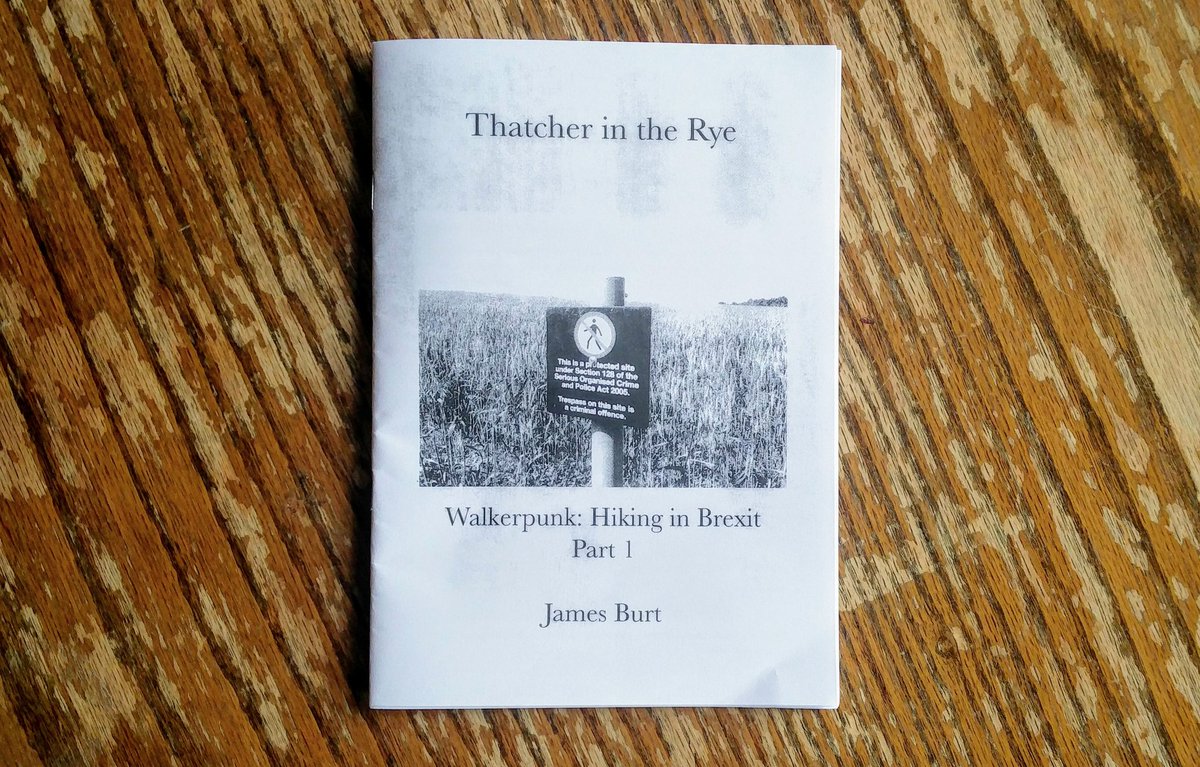
I’ve walked hundreds of miles on British trails this year; and I keep on thinking about Brexit.

I’ve spoken about the connections between walking and politics in my recent post on Teresa May. While my walks had no explicit connection with politics, I often thought about the coming changes.

Last year, walking the South Downs Way, it was a few months after the referendum. I was sure that nobody would be stupid to trigger article 50 without a plan, and any sort of plan was obviously some way off. It was still not clear what the simplistic question in the referendum actually meant – beyond ‘Brexit means Brexit’.

Then, in March this year, Article 50 was enacted and Britain is set to leave the EU. Months have passed and we’re no nearer knowing what that means, despite having a hard deadline of March 2019. Whatever happens, it looks like the country has a tough time ahead.

This Summer has had a feeling of pre-emptive nostalgia. As if right now might be as good as it gets for Britain in my lifetime. The banks are preparing to fly from the financial towers of London to Frankfurt and Dublin and Paris. Numbers of foreign workers are falling, despite the importance of imported labour for various part of the economy, like the fruit farms we strolled last weekend. After six months, little progress has been made on the negotiations. Project Fear was the wrong way to argue against Brexit, but I suspect it was closer to the truth than the sunlit uplands we were promised. Sovereignty is all very well, but it doesn’t help people pay their mortgages.

I’m a patriot about Britain. Just like Daniel Hannan and Teresa May, I love walking in the English countryside. I’m not proud of being British – it is just a coincidence, nothing to do with me. But I do like it – and hiking in Britain would be much more difficult in the future if I was European but not British.

My hiking has taken me through areas that voted both leave and remain. Everyone is friendly, but there is a tension growing. People who still want to remain in the EU have been called traitors by the mainstream press. Meanwhile, I’m about to lose a lot of rights I was born with. I am about to be dragged into a country I don’t really know. (I saw a ‘remainer’ told that, if they liked Europe so much, they should go and live there; they already do).

There is no real opposition to Brexit at the moment. Apart from tarnished Tony Blair, nobody has put forward a serious rallying cry for stopping Brexit, despite the numbers who are angry and confused by it. Simon Indelicate writes about the rift in his essay Which People Have Spoken? – “It will never, ever, be OK. Something has broken between us.” If Brexit does not go very well, there will always be a simmering resentment.

Walking the Pennine Way, I stayed at a peaceful B&B. Over breakfast, the conversation turned to Brexit. I had been avoiding the subject, as I didn’t want the confrontation. Why spoil the holiday? But the host bought it up, she told us how eastern Europeans were laughing at us, explaining how people from one nation spent their welfare money on drink at the weekends, and on Monday demanded nappies from the state. My companion had voted leave, but was also strongly in favour of EU immigration. He had often employed such nationals, seeing them as hard workers, and his business relied on them.

I stayed polite as I objected, but I know that these conversations will become more difficult, less patient. I’m not sure how easy it will be to tolerate each other if things go wrong. If Brexit is a success, we can all laugh at how foolish the remoaners and the traitors were. If it doesn’t work out, then there is nothing to make up for the things being stolen from the people who voted to remain.

I walked another part of the Pennine Way during the run-up to the May election. There seemed little sign of that in the countryside – unlike the referendum, where farmers would put out signs in their fields. Maybe we saw few traces of the election because we were walking through safe seats (although, it turns out, not as safe as first thought). Or maybe it was because the election was irrelevant. The referendum overrules representational democracy, and parliament has become subservient to it; a narrow victory in a non-binding vote is now being taken for a permanent mandate. The return of sovereignty seems to involve Parliament being removed from the constitutional process.

It will never, ever, be OK.” Last weekend, on the North Downs Way, we followed part of Watling Street, the subject of John Higgs’ recent book. We found ourselves at one end of the road while, coincidentally, Mr. Higgs was at the other end in Anglesey. John wrote his book in the summer just after the referendum, when the questions of nationality were first stirred up. John looks at the different ways of being British, and his vision is a wide, inclusive one – nationality, he says, “only exists at a distance”.

In the book, John refers to Pierre Teilhard de Chardin’s theory of the noosphere, the world of human thought. This is the highest in a hierarchy of spheres, from the geosphere of rock and ocean, through the biosphere, the world of living things. They interact, but change at different speeds. In some places, the noosphere has altered the geosphere, like the Uffington horse or the stones at Avebury.

Hiking has given me a feel for the British geosphere that I never had before. Much of that will remain unchanged by what’s coming. The geosphere, the rock and damp that created the first ideas of Britishness, that will ensure. But the noosphere is in a mess, a tangle of broken ideas. It may never be OK again in my lifetime.

I find myself wondering if it is time to leave the UK. I want to stay, because this was my home; but it’s feeling less and less like home. The metric weights and European nature that were part of my Britain are being removed. I want to stay, but I feel unwelcome.

Between my two most recent hikes I went to Dublin on business. The city is booming and preparing for more growth after Brexit. From what I read, so are Frankfurt and Paris. There will be jobs there for British people after Brexit. I don’t know if I want to stay in this country, rather I might be better to treat it as a holiday destination. A place to go hiking.

These are the sorts of thoughts I consider while hiking. I’m sure Daniel Hannan has equally profound thoughts on the English hills. While mine are all over the place, I have some very particular things to discuss in detail next month, as part of The Indelicate’s October Ritual event (which also features John Higgs). Beyond my personal feelings, there are some deep links between hiking and Brexit.